Tag Archives: URA

URA launches sale of River Valley site

Martin Place residential site resize

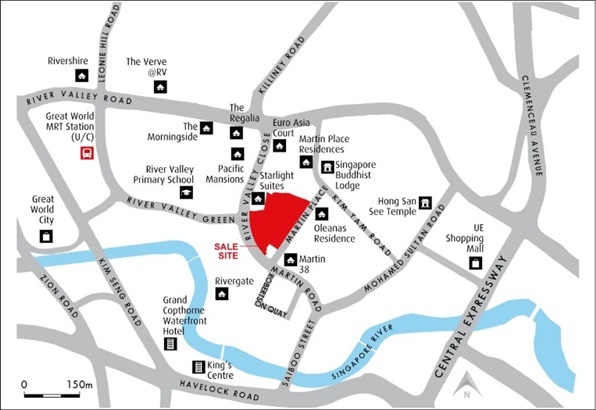
Location of the land parcel at Martin Place.

A prime residential site at Martin Place in River Valley has been launched for sale by public tender, according to the Urban Redevelopment Authority (URA).

Released under the confirmed list of the first half 2016 Government Land Sales (GLS) Programme, the approximately 171,535 sq ft site has a maximum gross floor area of 480,307 sq ft. It could potentially yield about 450 condo units.

The 99-year leasehold site is located close to the future Great World MRT station on the Thomson-East Coast Line. Nearby condominiums include Martin Place Residences, Rivergate and Martin 38.

Desmond Sim, Head of CBRE Research in SEA, said: “This is a site that is expected to draw much interest due to its prime location. The last time a site was made available in the vicinity was back in March 2011 at Robertson Quay ($938 psf ppr). In addition, the last site awarded in District 9 was the Mount Sophia site back in September 2013 ($1,157 psf ppr).

“This shows that sites in the prime area from the GLS Programme are far and few between. As such, CBRE Research will not be surprised if the site garners eight to 12 bids, which will come from established property developers as well as a handful of joint ventures. CBRE Research expects the top bid to be in the region of $1,000 psf ppr.”

The tender for the land parcel will close on 28 June 2016, said the URA.

Martin Place sale site

Aerial view of the sale site. (Photo: URA)

URA revises rules for property developers

In a bid to promote accountability and protect the interests of home buyers, the Urban Redevelopment Authority (URA) recently revised the criteria for issuing sales licences for home builders, reported The Straits Times.

First, the minimum paid-up capital or deposit for those applying for a licence, has been raised from $1 million to between $1 million and $4 million, depending on the project’s size.

Those intending to build and sell a housing project with up to 50 units must have a paid-up capital of $1 million, $2 million for developments with 51 to 200 units, $3 million for projects with 201 to 400 units, and $4 million for larger developments.

Second, developers can no longer cite non-residential projects in the track record, to be submitted as part of their sales licence application, as commercial and industrial projects differ from residential developments.

According to Nicholas Mak, Head of Research and Consultancy at SLP International, this would prevent some smaller players in the industrial sector from venturing into the housing market.

Third, the number of units that a developer can be allowed to build will depend on the size of the completed developments specified in the track record.

If a company has completed fewer than 10 units, it can only obtain a sales licence for a new housing project with less than 50 units. Those who have constructed 11 to 50 units are permitted to build fewer than 200 units. Those with 51 to 100 units under their portfolio are eligible for developments with less than 400 units, while firms that have built over 100 units have no restrictions.

This new rule will safeguard buyers from developers who want to launch many units, but don’t necessarily have the experience, said Augustine Tan, President of the Real Estate Developers’ Association of Singapore (REDAS).

Finally, for developers applying for a sales licence based on the track record of their companies, at least one of its directors involved in the previous project must remain in his or her position.

“Developers can always disappear from Singapore after taking profit… But if they have a couple of people who are qualified directors, these people would hopefully behave more responsibly and can be held accountable,” noted Ku Swee Yong, Chief Executive, Century 21.

The changes will apply to all new licence applications received from 1 April 2016 onwards.