Developers sold more units in June than in 2007 peak but the momentum may not last
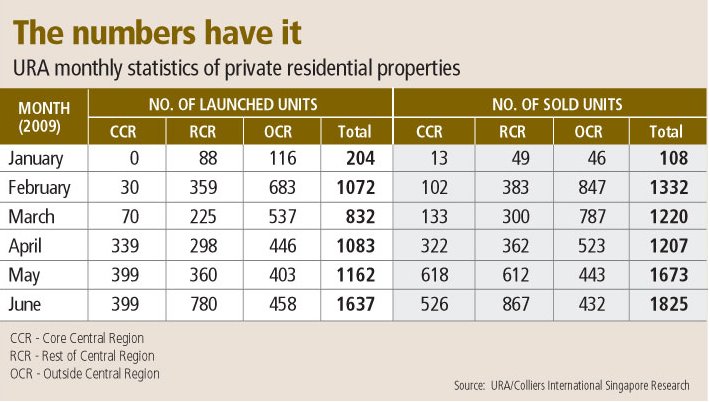
(SINGAPORE) The buying frenzy in Singapore’s property market has now eclipsed even the dizzy heights of the last property boom. Developer sales of new private homes in June hit 1,825 units – topping the previous peak of 1,723 units homes sold in August 2007 at the property market peak.

But analysts are unsure if the buying momentum can continue for much longer.
June marks the fifth straight month where the number of transactions has exceeded 1,000. To capitalise on the bullish sentiment, developers increased supply by 41 per cent month-on-month to launch 1,637 units in June.
In the first half of 2009, developers sold more than 7,300 units in all. If this momentum is sustained, new home take-up for the full year will exceed 14,000 units.
That figure could be met, some analysts said. In 2007, a record 14,811 units were sold, in what one analyst said was ‘the climax of the bull run in terms of sales volume’. CB Richard Ellis (CBRE), for example, said that it is likely that the whole year’s new home take-up will be around 12,000-14,000 units.
But others are more doubtful. DBS Vickers analyst Adrian Chua expects developers to sell just 9,000 new homes in 2009. That figure is itself an upgrade from his previous assumption of 6,000 units.
Colliers International’s director for research and advisory Tay Huey Ying noted that June’s record number of primary home sales is driven by pent-up demand from both owner- occupiers and investors, and was also helped by the fact that home prices remained largely at a discount from their peaks despite recent signs of strengthening. Official data shows that private home prices fell 14.1 per cent in Q1 2009 and another 5.9 per cent in Q2.
‘As the primary market is perceived to have bottomed, people have rushed in to buy ahead of sharp price increases and the Hungry Ghosts Month,’ Ms Tay said. ‘Nevertheless, buyer sentiment and buying momentum remain susceptible to downside risks as well as runaway home prices as buyers remain price-sensitive, given the lack of economic and income growth.’
But analysts are encouraged by two factors: firstly, the fact that the high-end market seems to be picking up. Colliers’ analysis showed that some 11 units were transacted at more than $2,500 per square foot (psf) in June, up from just three units in May. By contrast, no new homes were sold for more than $2,500 psf in the first four months of the year.
In addition, the $3,000 psf mark was breached as well. UOL managed to sell one unit at Nassim Park Residences at $3,813 psf, which is the high watermark price for the year so far. A unit in the Ritz-Carlton Residences was sold at $3,404 psf while another in The Orchard Residences was sold for $3,299 psf. In fact, seven units at The Orchard Residences were sold in the price range of $2,700-$3,299 psf.
The trend, at least, looks set to continue in July. Analysts said that several other luxury units have also changed hands so far this month.
And, secondly, some are optimistic as this rally is a bottom-led recovery, which analysts said should be more sustainable than the previous boom. The 2006-07 run-up was led by investment interest in the high-end segment.
‘This time, mass market projects (supported by the relative stability of the HDB resale market, which is still seeing limited supply) are driving the market bottom- up,’ said DBS Vickers’ Mr Chua. ‘Also, smaller units continue to be snapped up first, in contrast to the penthouses and larger units in the 2006-07 run-up. We believe the current run-up is still largely premised on affordability (with investment interest skewed towards rental yields) whereas the 2006-07 run-up was based on an investment interest premised on capital appreciation and the luxury scarcity factor.’
And there still appears to be support at the bottom. According to an analysis by Jones Lang LaSalle (JLL), the price gap between non-prime residential projects and HDB resale flats has come off from the peak of 67 per cent in 2007 to a low of 54 per cent in 2009. ‘In our opinion, the narrower price gap is a major factor behind the bullish sentiment, especially among HDB upgraders. As long as this gap remains tight, this stream of HDB upgraders into the private residential market is likely to continue,’ says Chua Yang Liang, JLL’s head of research for South-east Asia and Singapore.
Source: Business Time 16 July 2009



 Lush Dream Home