Monthly Archives: July 2009

Home sales still going strong

When private home sales unexpectedly jumped in February, in the thick of Singapore’s worst-ever recession, pundits called it a false dawn and warned that the rally would not last.

But now, the market has sustained its rebound for five straight months and is expected to keep growing.

Figures released last Wednesday showed that last month’s new home sales hit a record high of 1,825, while recent news reports indicate that this month’s sales figures will still be strong.

All this has prompted previously sceptical analysts to turn more decidedly positive on the sector.

At least three research houses – UOB Kay Hian, DMG & Partners and DBS Vickers – are now overweight on Singapore property, which means they see property stocks as better valued compared with stocks in other sectors.

Why the change in sentiment? Recent data offers a whole host of reasons, according to the analysts.

One is that the worst of the economic crisis is over, and Singapore in particular looks to have turned the corner. Last Tuesday, the Government said the economy jumped 20.4 per cent between March and June to rise out of recession, pulling up market confidence and the full-year growth forecast along with it.

In the same quarter, developers sold 4,714 brand-new units – already more than the 4,370 they sold for the whole of last year.

The improvement in home sales is also spreading to more segments of the market, said UOB Kay Hian’s property analyst Vikrant Pandey.

While the rally in private home sales started in entry-level homes – a result of pent-up demand from HDB upgraders and genuine owner-occupiers shut out of the last property boom – the positive sentiment has widened to include pricier units.

Sales of high-end and luxury homes have gained traction recently, with ‘a steady increase noted in the number of transactions above $1,500 per sq ft since the beginning of this year’, said Mr Pandey.

Last month, high-end sales were boosted by the 146 units sold in One Devonshire in Somerset, at a median price of $1,771 psf. Three units were also sold above the benchmark price of $3,000 psf: at The Orchard Residences, Nassim Park Residences and The Ritz-Carlton Residences.

Most importantly, the rebound is pushing property prices up in some projects – and buyers are still biting.

Despite prices increasing by 5.2 per cent on average last month, buyers seemed undeterred, said DMG analyst Brandon Lee.

‘We attribute it to the buoyant HDB upgrader demand, pent-up demand, low interest rates and improved macro-economic landscape.’

More pent-up demand may still be on the way, from buyers who sold their previous units en bloc and have yet to buy another home, said DBS Vickers analysts Adrian Chua and Lock Mun Yee in a report published last week.

They also take heart from the fact that long-held fears of an impending surge of new units have failed to deflate the market.

‘We believe we should not see a short-lived spike unless prices rise beyond economic fundamentals,’ they added.

But not all analysts are so upbeat.

OCBC’s Mr Foo Sze Ming has maintained a neutral rating on the property sector because he thinks that there will be no additional impetus for home sales to keep rising.

In fact, he said the number of unsold suburban homes rose last month for the first time in four months – evidence that the pent-up demand from HDB upgraders has been gradually met.

What is now helping to drive demand for new homes is sideline liquidity from investors who see a chance to get in on the action.

But he said it remains uncertain as to how long this can last. Unless wages start rising again or foreign funds start coming in to buy Singapore property – neither of which Mr Foo thinks is likely to happen soon – the recovery may well peter out.

Of the stocks that analysts are now bullish about, City Developments seems one of the most popular due to its relatively large exposure to the Singapore residential market.

UOB Kay Hian and DBS also like Ho Bee, which has both mid-end and high-end projects, and Allgreen, which has at least two mid-tier projects launch-ready.

Source : Sunday Times – 19 Jul 2009
Horizon brightens for property groups

THE outlook is more sanguine, as listed property developers get ready to announce their financial results for the six months ended June 30. The strong pick-up in private home sales in the past five months – and a nascent recovery in prices – is providing cheer, contrasting with the gloom that lasted until the early part of 2009 after the financial meltdown.

JP Morgan analyst Christopher Gee is tracking ‘if developers’ own outlooks and strategies have changed as a result of the upturn in home sales and general economic prospects’.

Against a brighter horizon, some concerns prevalent among property analysts six months ago have lessened. The pressure on developers to write down the values of their Singapore residential sites has abated. So too has the risk of buyers who bought on deferred payment schemes (DPS) not completing their purchases.

‘The secondary market is getting more active, so it should be easier for DPS buyers to sell their properties before the projects receive Temporary Occupation Permit,’ says DMG & Partners Securities analyst Brandon Lee.

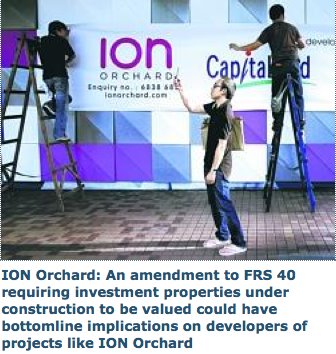
Macquarie Securities research head Soong Tuck Yin says an interesting development to watch out for is an amendment to Financial Reporting Standard FRS 40 requiring that investment properties under construction be valued, and the increase or decrease be taken to the income statement.

The change took effect at the start of this year, and with many major listed companies doing valuations at half-year and full-year, there could be bottomline implications for the likes of CapitaLand for its ION Orchard mall and Vista Xchange at one-north for instance; and Keppel Land for its Ocean Financial Centre and Marina Bay Financial Centre projects, Mr Soong suggests.

Before the rule change, these companies were required to state only their completed investment properties at fair value. KPMG Singapore’s head of real estate Yap Chee Meng explains: ‘In the past, investment properties under construction were carried at cost unless there was impairment. Financial Reporting Standards now require these to be fair-valued where the fair-value model is used for investment properties, and where the fair value can be reliably determined.

‘For Singapore, this was effective from Jan 1, 2009. I would expect property companies to start reflecting it in their income statements from this current reporting season (the quarter ended June 30), as property companies normally revalue their investment properties once or twice a year.’

Analysts say City Developments’ bottom line is unlikely to be affected by the change to FRS 40 as it currently accounts for all its investment properties using the cost model.

For other listed developers that use the fair-value model, there is also the issue of how aggressively they will write down valuations of completed investment properties, particularly office blocks. ‘Asset write-downs, especially for commercial assets, have not materialised in a meaningful way,’ says CIMB-GK analyst Donald Chua. ‘With rents and occupancies falling, it will be interesting to see if property groups devalue their assets more aggressively this reporting season.’

Mr Gee, however, notes that the policy of stating investment properties, completed or otherwise, at fair value affects a developer’s accounting bottomline – but does not have any real cashflow impact.

As for profit from residential projects, Mr Soong says that strong home sales by developers lately will translate into profits to be recognised, although for projects in the initial stage of construction, earnings may be booked only in the current second half or next year.

CIMB-GK’s Mr Chua expects developers’ latest report cards to show declines in gearing ratios. Some of the bigger boys have recapitalised through rights issues, he says. Smaller players should also be able to use proceeds from strong home sales recently to pare debt.

A key thing to monitor in H2 is whether residential sales momentum continues. Mr Chua is keeping tabs on ‘prices and take-up rates at the high end and the level of foreign demand, especially as we draw closer to the opening dates of the integrated resorts’. ‘It may be interesting to see if projects on Sentosa Cove are released closer to the end of the year.’

Home buyers defaulting on purchases or returning options issued on high-end projects sold in the past month will also be on his watch-list.

DMG’s Mr Lee expects developers to launch more mid and prime sector projects in H2 and to start buying residential sites again, ‘especially those with drying land banks’.

JP Morgan’s Mr Gee said stockmarket investors are looking out for sustained increases in physical property prices and upgrades in revalued net asset values for listed property groups.

Source : Business Times – 17 Jul 2009