Tag Archives: Singapore Residential Price Index

New monthly index of private home prices

A NEW index that tracks the price of private non-landed homes month by month has been created to help owners, investors and other property watchers keep a handle on the fast-moving market.

The Singapore Residential Price Index (SRPI), as it is called, has been formulated by the National University of Singapore (NUS) after two years of research.
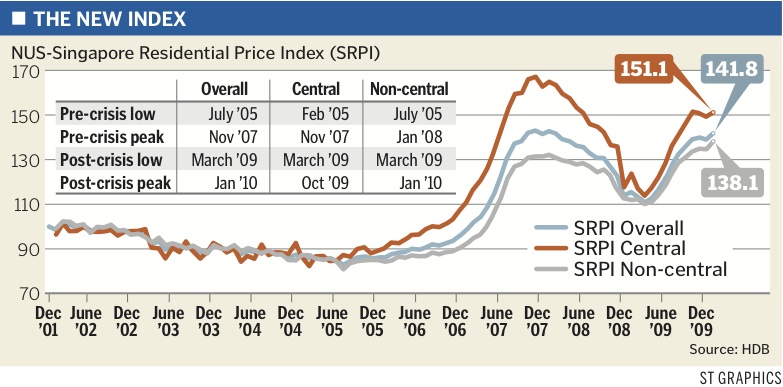
It functions much like the Straits Times Index for shares but instead of following certain stocks, the SRPI is based on the transacted prices of a selected basket of completed non-landed private homes.

The only other index that tries to get a grip on the property market is one put out by the Urban Redevelopment Authority, but that is only published quarterly.

It is compiled based on all types of private home transactions and is intended to provide a broad indication of price trends.

The new index, which has a narrower focus, was launched yesterday by Senior Minister of State for National Develop- ment Grace Fu.

Ms Fu told the function at the Four Seasons hotel that the index can help analyse price trends and assist investors in making more informed decisions.

Associate Professor Lum Sau Kim, who led the NUS project, said formulating the index was motivated by industry interest in property derivatives.

These financial products can give investors exposure to real estate or help others manage risks in their investments.

The SRPI reflects such risks. It is based on a basket that broadly represents the target market, so landed homes, forming such a small segment, are excluded.

It also excludes projects that are more than a decade old, those that are small, rarely traded, or targeted for en bloc sale.

The basket will change every two years to reflect changes in the completed stock of private non-landed homes.

Its initial make-up comprises 74,359 units in 364 projects across 26 postal districts, completed between October 1998 and September last year.

Only completed homes are used so as to reduce the influence of new launch prices and sub-sales, which may not reflect the market. Care will also be taken to dampen the effect of one-off deals or over-the-top prices.

‘Once it is an index that people trade on, it has to be very robust to guard against manipulations,’ said Savills Singapore managing director Michael Ng.

While property derivatives may be some time away, the SRPI’s immediate benefit will be in providing reliable price data, said Mr Simon Cheong, president of the Real Estate Developers’ Association of Singapore.

Mr Cheong said it is all the more timely as the non-landed homes sector is going through ‘a particularly volatile period with shorter cycles where market watchers are eagerly looking for more transparency and greater clarity on market movements’.

Cushman & Wakefield managing director Donald Han added: ‘We’re seeing higher volumes and rapid movements in prices, so there’s a need to have a monthly coverage of property prices.

‘The SRPI will have a more accurate picture. It helps to reduce panic.’

Updated on the 28th of each month, the SRPI is on the NUS website at www.ires.nus.edu.sg/srpi_main.aspx

Source : Straits Times – 25 Mar 2010

A better picture of the private property market

New, monthly price index will also help in development of property derivatives

Singapore now has a second price index to provide information on the state of the private housing market here.

The new Singapore Residential Price Index, or SRPI, aims to provide a resource for the development of property derivatives. It tracks month-on-month price movements in the private non-landed residential property market.

Right now, property investors have just one price index to work with: the Urban Redevelopment Authority’s (URA) private residential property price index. That index is released on a quarterly basis and has sometimes been criticised for lagging a fast-moving market.

The National University of Singapore’s Institute of Real Estate Studies developed the SRPI after a dialogue with industry players as well as help from the Monetary Authority of Singapore (MAS) and the Singapore Exchange (SGX).

The institute hopes that, as real estate grows in importance as an asset class in the region, the SRPI will serve as a benchmark index and a reference for structuring property derivative products.

‘As the index gains in acceptance, it can potentially be used for risk management through the development of products such a property derivatives,’ said Senior Minister of State for National Development Grace Fu, who officially launched the SRPI yesterday. ‘Such derivatives may be one way for real estate developers, asset managers, banks and investors to hedge their property exposure.’

The new index differs from URA’s in several significant ways. For one thing, it will be updated every month, instead of once a quarter.

The SRPI is also computed using the market values of a basket of only completed properties. Right now, the basket has 364 private residential projects located across the island that were completed between October 1998 and September 2009.

Uncompleted projects were not included in the basket as price movements in such projects can be vastly different from those seen for the rest of the market. But the impact of new launches on the prices of completed properties in the vicinity will be factored in.

The URA index, on the other hand, includes transactions at new launches and sub-sales.

The SRPI also considers the address, completion date, tenure, leasehold maturity, floor level and strata area of all units in the projects in its basket.

The differences mean that the two indices can throw up very different numbers.

According to the SRPI, prices of non-landed private homes rose 22.2 per cent from December 2008 to December 2009. But URA’s private residential property price index showed that prices of non-landed properties increased just 0.5 per cent for the whole of 2009.

And as for Singapore’s central areas, the SRPI showed a 27.3 per cent jump in prices from December 2008 to December 2009 for the ‘central region’ (postal districts 1-4 and 9-11). The URA price index, by contrast, showed that prices of non-landed properties in the ‘core central region’ fell 1.8 per cent over 2009.

Knight Frank chairman Tan Tiong Cheng pointed out that the methodology used to develop the SRPI is ‘clearly spelled out’ while that used by URA for its price index is ‘less known’.

‘This can lead to some misunderstanding of the URA price index, especially in a volatile market,’ Mr Tan said. ‘What it means is there will be a lag effect when price movements in a fast-moving market do not get reflected immediately in the price index. This became quite obvious when the market corrected itself significantly post-Lehman, and the URA index clearly did not reflect that.’

A developer BT spoke to also said that it might be easier to ‘bet’ on the property market using the SRPI, instead of the URA price index, as more information is available about how the SRPI is calculated.

But he warned that there will still be some lag effect in the new index as it still uses transaction data from URA. This is derived from caveats lodged by buyers, who can sometimes take months to lodge a caveat – or even choose not to lodge one at all.

URA said the SRPI is compiled for the purpose of trading property derivatives. It lets market participants refer to an index that tracks the price movements of a specific basket of properties, or the specific sector of the property market which they wish to gain exposure to or hedge against.

On the other hand, URA’s property price index is designed to provide the general public and industry players with a ‘broad indication of price trends in the private residential market’.

URA’s index captures ‘all transactions and so may present a different picture from specific parts of the market’, a spokesman said.

Source : Business Times – 25 Mar 2010