Tag Archives: Singapore Property

A better picture of the private property market

New, monthly price index will also help in development of property derivatives

Singapore now has a second price index to provide information on the state of the private housing market here.

The new Singapore Residential Price Index, or SRPI, aims to provide a resource for the development of property derivatives. It tracks month-on-month price movements in the private non-landed residential property market.

Right now, property investors have just one price index to work with: the Urban Redevelopment Authority’s (URA) private residential property price index. That index is released on a quarterly basis and has sometimes been criticised for lagging a fast-moving market.

The National University of Singapore’s Institute of Real Estate Studies developed the SRPI after a dialogue with industry players as well as help from the Monetary Authority of Singapore (MAS) and the Singapore Exchange (SGX).

The institute hopes that, as real estate grows in importance as an asset class in the region, the SRPI will serve as a benchmark index and a reference for structuring property derivative products.

‘As the index gains in acceptance, it can potentially be used for risk management through the development of products such a property derivatives,’ said Senior Minister of State for National Development Grace Fu, who officially launched the SRPI yesterday. ‘Such derivatives may be one way for real estate developers, asset managers, banks and investors to hedge their property exposure.’

The new index differs from URA’s in several significant ways. For one thing, it will be updated every month, instead of once a quarter.

The SRPI is also computed using the market values of a basket of only completed properties. Right now, the basket has 364 private residential projects located across the island that were completed between October 1998 and September 2009.

Uncompleted projects were not included in the basket as price movements in such projects can be vastly different from those seen for the rest of the market. But the impact of new launches on the prices of completed properties in the vicinity will be factored in.

The URA index, on the other hand, includes transactions at new launches and sub-sales.

The SRPI also considers the address, completion date, tenure, leasehold maturity, floor level and strata area of all units in the projects in its basket.

The differences mean that the two indices can throw up very different numbers.

According to the SRPI, prices of non-landed private homes rose 22.2 per cent from December 2008 to December 2009. But URA’s private residential property price index showed that prices of non-landed properties increased just 0.5 per cent for the whole of 2009.

And as for Singapore’s central areas, the SRPI showed a 27.3 per cent jump in prices from December 2008 to December 2009 for the ‘central region’ (postal districts 1-4 and 9-11). The URA price index, by contrast, showed that prices of non-landed properties in the ‘core central region’ fell 1.8 per cent over 2009.

Knight Frank chairman Tan Tiong Cheng pointed out that the methodology used to develop the SRPI is ‘clearly spelled out’ while that used by URA for its price index is ‘less known’.

‘This can lead to some misunderstanding of the URA price index, especially in a volatile market,’ Mr Tan said. ‘What it means is there will be a lag effect when price movements in a fast-moving market do not get reflected immediately in the price index. This became quite obvious when the market corrected itself significantly post-Lehman, and the URA index clearly did not reflect that.’

A developer BT spoke to also said that it might be easier to ‘bet’ on the property market using the SRPI, instead of the URA price index, as more information is available about how the SRPI is calculated.

But he warned that there will still be some lag effect in the new index as it still uses transaction data from URA. This is derived from caveats lodged by buyers, who can sometimes take months to lodge a caveat – or even choose not to lodge one at all.

URA said the SRPI is compiled for the purpose of trading property derivatives. It lets market participants refer to an index that tracks the price movements of a specific basket of properties, or the specific sector of the property market which they wish to gain exposure to or hedge against.

On the other hand, URA’s property price index is designed to provide the general public and industry players with a ‘broad indication of price trends in the private residential market’.

URA’s index captures ‘all transactions and so may present a different picture from specific parts of the market’, a spokesman said.

Source : Business Times – 25 Mar 2010
More auctions expected in high-end residential sector

The market is likely to chalk up more than $200 million worth of transactions this year, says GRACE NG

IT was a stellar year for auctions last year despite the unfavourable market conditions. About $168.4 million worth of properties were sold at auctions in 2009, doubling the $83.67 million done in 2008.

The residential sector was the star performer, chalking up $88.4 million worth of transactions, or slightly over half the total sales value. The retail sector was the next best performer, with $43.4 million worth of sales.

Strong interest was seen for shops and shophouses, as investors chose to park their money in higher yielding investments rather than keep it in the bank for paltry interest rates. The sector that saw the highest growth rate was industrial property. Sales value jumped 223 per cent, from $6.2 million in 2008 to $20 million last year.

Buoyant market pushes up sales

Mirroring the buoyant sales in the primary residential market, residential properties at auctions saw a 250 per cent jump in sales value in 2009. The figure soared from $25.2 million in 2008 to $88.4 million last year.

More residential buyers are turning their attention to auction sales because the properties available at auctions are deemed to be better value for money as most of the older properties tend to have much larger land or built-up areas.

In addition, buyers who are owner-occupiers can move into the property when the sale is completed, which is typically three months after the payment of deposit. In comparison, purchasing from a developer could mean a wait of about two years before the property is ready for occupation.

Popular picks in 2009

# Landed properties: Terrace and semi-detached. In our land-scarce country, owning a landed property remains the aspiration of many Singaporeans. It is also a status symbol, as these properties are only available to Singaporeans and permanent residents with approval from the Land Dealings (Approval) Unit.

Even though landed properties do not come with facilities like those found in cluster housing or condominiums, they remain popular, as such properties usually have a private garden and car porch and do not have maintenance charges. Thus, it is not surprising that landed houses have become popular at auctions.

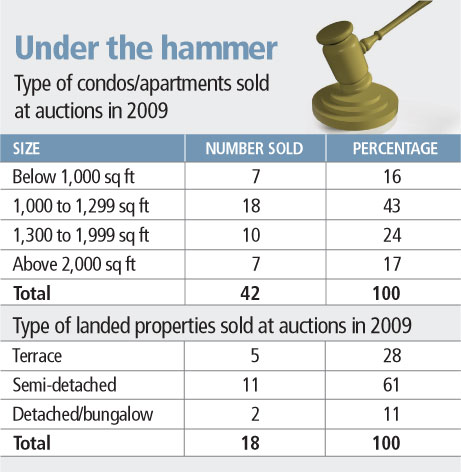
In 2009, terrace houses costing around $1 million and below were in demand because of their affordability. Five terraces were sold at prices ranging from $820,000 to $1.25 million.

Corner terraces and semi-detached houses, especially those that sit on large land areas, were the favourites, as these properties are rarely available. A total of 11 semi-detached houses were sold during the year at prices ranging from $1.05 million to $3.7 million. The majority of the transactions were below $2 million and the properties had land areas ranging from 2,400 sq ft to 4,414 sq ft.

Buyers also favoured semi-detached houses with large land areas. Nine of the 11 semi-detached houses sold at last year’s auctions had land areas in excess of 3,500 sq ft.

The popularity of this type of property can be attributed to the fact that newer semi-detached houses have smaller land areas of about 2,150 sq ft, which could translate to a higher price per sq ft.

# Apartments with large floor areas: With developers building smaller apartments – some of them dubbed Mickey Mouse flats – in their new developments, the older and larger apartments have become a popular alternative at auctions with owner-occupiers as well as upgraders.

Apartments in the secondary market are generally larger with a 2-bedroom unit averaging 800 sq ft, a 3-bedroom 1,250 sq ft and a 4-bedroom unit 1,800 sq ft. In comparison, new apartments today are much smaller starting from 300 sq ft for a studio, 527 sq ft for a 2-bedder and 861 sq ft for a 3-bedder.

Given the limited number of large apartments in the primary market, many throng the auction halls in search of their ideal apartments. Apartments ranging from 1,000 sq ft to 1,299 sq ft were popular at auctions. Eighteen out of the 42 units sold last year fell within this category.

The apartments bought were at various locations. At International Plaza at Tanjong Pagar, a 1,033 sq ft 2-bedroom apartment was sold at auction for $800,000. At Shanghai One in River Valley, an 883 sq ft 2-bedroom unit went for $1.08 million and in Oxford Road, a 1,097 sq ft 2-bedroom apartment in Kentish Green was sold for $620,000.

# Properties below $1million: Apartments and condominiums below $1 million were popular too, as evidenced by the 27 successful transactions seen in this category out of the 42 made available at auctions.

# Apartments in prime districts: The other property type that was sought after at auctions in 2009 was high-end apartments. Apartments located in the prime inner city and District 10 under mortgagee sales were in demand. Two apartments at The Clift were sold for $605,000 and $1.047 million. Another two apartments at Four Seasons Park were sold for about $4.8 million each.

What will be popular in 2010?

In line with the recovery in the high-end sector, homes in districts 9, 10, 11, as well as prime inner city and Sentosa, will continue to be popular at auctions. We can expect to see an increase in sales of homes in these areas this year. The proportion of apartment sales is likely to rise to 35 per cent compared with 29 per cent achieved last year.

The opening of the two integrated resorts (IRs) will enhance Singapore’s reputation as a world-class city. Residential properties located near the two IRs were given a boost in value as a result, and were in demand as buyers aimed to cash in on the market.

Apartments such as The Sail and Marina Bay Suites, as well as properties in Sentosa Cove, will be sought after by investors and owner-occupiers alike.

Prices of high-end homes in the Core Central Region are still about 11 per cent below their Q1 2008 peak. Improving market sentiment in line with the recovery in the economy, ample liquidity and a low interest rate environment, as well as a hunger for alternative investment opportunities, are factors pointing to a recovery.

As such, we are likely to continue to see owners taking the auction route this year to sell their high-end properties in hopes of achieving the best price through competitive bidding.

We could also see some developers exploring auctions as a mode of sale for their properties if the high-end market picks up steam.

Some developers had success when they used an auction to sell their high-end properties. For instance, 12 parcels of bungalow land in Sentosa Cove were successfully auctioned off in 2006 for a total value of $86.34 million.

And in 2007, another developer successfully auctioned 12 luxury apartments at The Botanika for $52.92 million, which set new benchmark prices for the area.

The competitive bidding helped these developers achieve record prices for their developments, and they also gained international exposure as the auctions were beamed live via satellite to cities such as Hong Kong, Jakarta, London and Sydney to tap foreign buyers.

With an improved economy, the number of properties sold at auctions this year should rise to more than 140, from the 118 seen in 2009.

More activity is expected in the high-end residential sector and this is likely to boost the sales value at auctions. As such, the market is likely to chalk up more than $200 million worth of transactions this year.

Grace Ng is deputy managing director (agency & business services) and auctioneer, Colliers International

Source : Business Times – 25 Mar 2010