Tag Archives: Singapore Property Market

Mixed development en bloc sales need incentives

Collective sales of such properties tend to be slow

SINCE the phenomenon of collective sales started in 1994, there have been over 400 en bloc developments sold to date. Of these, only a handful, possibly about 10 or so, were mixed developments, that is, buildings with a variety of uses like shops, offices and apartments. Most of the successful en bloc sales were purely residential developments, or those with a few shops within the condominium.

In the most recent property boom in 2006/07, prime land and buildings were hot commodities, and en bloc sales were the predominant way for developers to lay their hands on them. So if demand was so strong, why were there so few sales of prime strata titled commercial or mixed developments?

Firstly, only a minority of mixed developments and shopping centres in Singapore are strata titled. The majority of them have single owners – usually an institutional fund, trust or investment company. Take Raffles Place as an example. Of the 30 office buildings located in the vicinity of the MRT station, only three are strata titled.

It is relatively easy for single owners to monetise unused plot ratios or give a facelift to their building. These moves usually enhance the owner’s investment returns which serve to motivate the building’s redevelopment or refurbishment.

Keppel Land, for example, tore down Ocean Building and is redeveloping the site into Ocean Financial Centre. OUB Centre has an annex block under development. Shell Tower was transformed several years ago into a modern office block, now called Singapore Land Tower.

However, amid these spanking new Grade A offices in Raffles Place, there are some old strata-titled buildings like The Arcade and Clifford Centre, which many regard as tired and outdated.

In the case of strata-titled buildings, especially those with no major owners, the motivation to build consensus among the owners and incur large sums to upgrade common areas is usually not high.

Owners of many older strata-titled complexes have contemplated pursuing an en bloc sale. But in most cases, they find it difficult to devise a formula to distribute the sale proceeds among the different use groups.

This is made more complicated by the allotment of share values which vests more shares per square metre for shops than offices. Apartments are in third place. The weightage ratio determined by the authorities is 5:4:1 respectively.

To add to the complexity, some old commercial buildings even have their car park space separately strata titled, as in the case of Orchard Towers and Shenton House.

Aside from the challenge of slicing the sale proceeds among the different use groups, finding an equitable apportionment formula for the retail units can be difficult. The values of two shop units of equal size located in different parts of the same floor can differ tremendously. A unit facing a busy concourse, escalator or with a main road frontage could be worth double a unit of the same size tucked away in the rear or close to the toilets or loading bay.

Another challenge that owners of shop space tend to face – especially those that run thriving businesses from their units – is the heavy cost of relocating. There are fit-out costs, business disruptions and perhaps most significantly, the loss of goodwill when they move. The goodwill factor is difficult to quantify and factor into any apportionment formula.

For some trades, there could be just one or two buildings they can consider operating in. The rest simply do not work. For example, a major computer retailer would not for a moment contemplate anywhere other than Sim Lim Square or Funan DigitaLife Mall.

For many shop owners, the motivation to sell may not increase as the building ages, especially when they enjoy a thriving business arising from a unique location.

Little wonder then that major mixed developments or strata titled retail buildings that were sold en bloc – like Katong Mall, Kim Seng Plaza, UIC Building and Kim Tian Plaza – had one or several major owners who controlled substantial portions of the floor space and share values. Without that, getting a consensus of more than 80 per cent may not have been possible.

The main aim behind the en bloc law that allows for a majority rather than a unanimous vote is to facilitate urban renewal. Over the past 10 years, the en bloc phenomenon has helped transform Singapore’s urban landscape in many precincts as modern buildings replace old ones.

So, if the en bloc sales mechanism in its present form does not work effectively for ageing strata-titled mixed developments or shopping centres, town planners may need to think of alternative solutions for them.

One option is the classic ‘carrot-and-stick’ approach. Provide the owners incentives to band together to sell collectively or spruce up the building within a reasonable time frame. The incentives may be bonus plot ratios or reductions in development charges (DC) which would enhance the monetary gains if they comply within the time frame.

In 1994, the Urban Redevelopment Authority (URA) had successfully transformed the Hillview area near Upper Bukit Timah from an old industrial belt into a district of modern condominiums, with the aid of time-sensitive bonus plot ratio carrots. That was a win-win approach.

The alternative is the draconian win-lose approach of invoking the state’s land acquisition powers.

The situation is by no means dire. Some could even argue that older buildings with all their imperfections widen the range of offerings at economical rates.

Old office buildings offer more affordable rents to price-sensitive businesses. Some old shopping centres like Queensway Shopping Centre and Katong Shopping Centre appeal with their specialty goods at cheaper prices, not to mention the nostalgia of their older setting.

Karamjit Singh is managing director and Pamela Kow is senior manager of Credo Real Estate

Source : Business Times – 25 Mar 2010
New engines drive expat rental hubs

DESMOND SIM says demand likely from financial, biomedical sectors

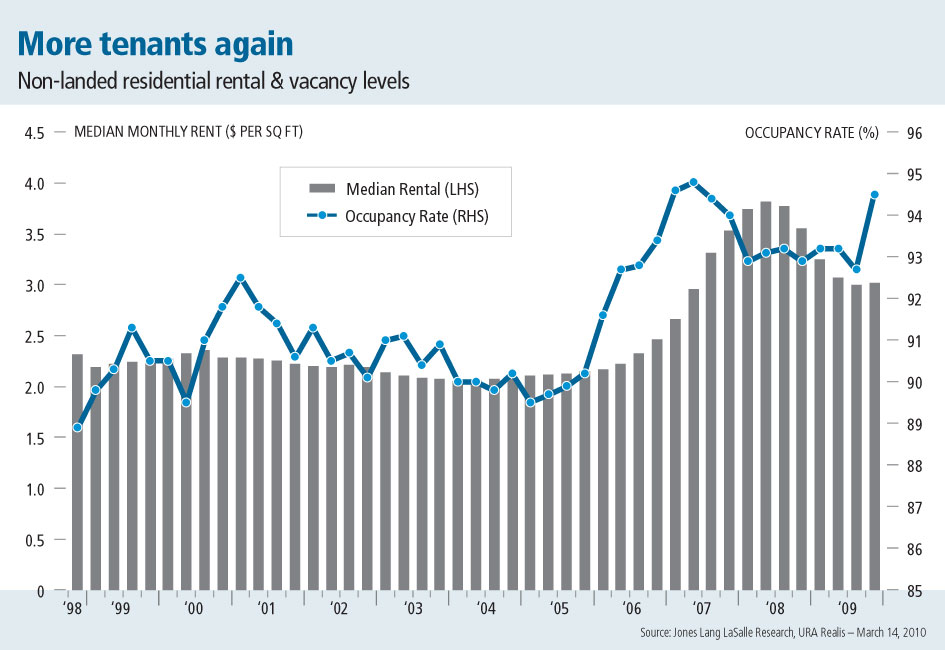
THE leasing market for non-landed homes showed signs of recovery in the final quarter of 2009, going by Urban Redevelopment Authority numbers. Median rents saw their first quarter-on-quarter growth of 0.5 per cent following five quarters of continued decline from a peak in Q2 2008. The monthly median rent in Q4 2009 was $3.02 per sq ft. Occupancy rates also jumped, achieving 94.5 per cent in Q4 2009 – a level previously seen only in 2006/2007.

While these indicators may suggest a recovery in the leasing market, the strength and sustainability of this positive turn are yet to be ascertained.

Overall, leasing demand has been rising over the years as a result of a boost in the foreign workforce. Singapore’s strategy to open its employment market to more foreigners has benefited the leasing market as this transient group looks for short-term housing in the private residential market. The population of Singapore has grown from 4.03 million in 2000 to 4.99 million in 2009. The number of foreigners grew in tandem from 754,500 in 2000 to 1.25 million in 2009.

On the back of better economic performance, the Ministry of Trade and Industry has revised its growth forecast for 2010 from a range of 3-5 per cent to 4.5-6.5 per cent. Job creation has improved, marked by the doubling of total employment from 14,000 in Q3 2009 to 37,500 in Q4 2009. The result is the creation of some 37,600 jobs for the whole of 2009 – a remarkable feat considering the economy was in a recession.

Although the number of foreigners employed has declined by 4,200 in 2009, there are still some 1.05 million of them working in Singapore. The job losses were mainly in the manufacturing sector. The construction and services industries, on the other hand, gained 19,700 and 10,400 new hires respectively.

Demand by industry

Anecdotally, leasing demand remains driven by the financial industry. This sector is making a strong rebound from the financial tsunami, with total employment in Q4 2009 turning a positive 3,000. This trend is expected to continue, further supported by recent poll results from the Business Expectations for the Services Sector Q4 2009 survey by the Department of Statistics. The financial services sector has the most positive outlook in terms of employment and general business expectations.

In addition, based on the latest report on wages in Singapore by the Ministry of Manpower, the financial services sector recorded the second highest median gross wage in 2008 at $9,170 per month for managers aged 35 to 39.

The other emerging leasing demand driver is the biomedical industry. Under the government’s aggressive drive to develop Singapore into a biomedical hub, the country reportedly bagged some US$2 billion worth of investments over the past four years. They include plans to set up six new biologics manufacturing plants that are expected to create some 1,380 jobs. Despite the manufacturing sector reporting negative 4.1 per cent growth in 2009, biomedical manufacturing expanded by 11.5 per cent.

Looking ahead, new leasing demand is likely to come from either the financial or the biomedical industry.

Demand profile

The foreign employment market today is different from what it was a decade ago. Currently, instead of the traditional top management hire, foreign employment involves more middle management to executive levels with a limited housing budget. These expatriates are likely to be young executives working for a financial institution or researchers and laboratory executives. Despite the increase in foreign employees, the average housing budgets have remained relatively low. These new expatriates are likely to be given a housing allowance and are motivated by cost savings. They either downsize or seek discounted rents whenever the opportunity presents itself. As a result, smaller residential units close to their workplace or with good accessibility to public transport remain the main attraction.

Based on rental transactions recorded by URA Realis and sorted by districts, several observations can be made from the rental transaction volume over the decade.

While the prime districts of 9, 10 and 11 remain the traditional hot spots for leasing, the number of leasing deals there has been observed to be falling. At the same time, the Central Area (CBD/HarbourFront) comprising districts 1 to 5 has gained popularity as can be judged from the increase in leasing volume. A key factor is the revival of inner city living with tenants attracted by the proximity to the CBD, the arts and cultural activity, and other amenities within the area.

In addition, there are two emerging regions where we expect strong leasing demand in the future.

Based on the backroom operations of multinational financial institutions such as Credit Suisse, Citigroup and Standard Chartered Bank, residential projects in the vicinity of the Changi Business Park will be in demand. As such, we expect leasing demand growth in Simei, Upper East Coast and Tampines (Districts 16,17 and 18).

With the biomedical industry expected to expand in Biopolis, leasing demand in residential projects in the vicinity of this purpose-built biomedical estate (District 5) is also expected to increase.

The drivers and leasing profiles have changed dramatically over the decade. This has influenced developers’ product offerings and also recently caught the attention of investors who have been making a beeline to these areas.

Evolving supply

Over the decade, developers have also been tweaking their product offerings to match changing demand. Overall, the market supply is shifting towards smaller apartments. Smaller units are easier to lease while maintaining a high per sq ft rental value. Similarly, smaller units are also more palatable in terms of absolute quantums paid. At the same time, developers are able to maintain their selling price on a per sq ft basis. Using a sample of major launches in the prime districts (9,10 and 11), an analysis of the composition by bedrooms was done. Studio apartments were excluded from the analysis.

There is a stronger focus on units with fewer bedrooms. Increasingly, one and two-bedroom apartments are found in the new supply. Based on the sample comparison study, one and two-bedroom apartments account for half the supply launched currently. This compares with 2000, when two-bedroom apartments made up just 15 per cent of the supply (with no count of one-bedroomers). This sample comparison shows that while demand has shifted over the decade, developers are also redesigning their product offerings to accommodate these changes.

Market outlook

After a challenging 2009, Singapore, along with the rest of Asia, is expected to experience a strong economic recovery this year. Financial markets are reported to have stabilised, while trade flows and industrial production have also picked up strongly. However, the recovery in Europe and the US remains weak. A pan-continental movement of talent from Europe and the US to Asia can be expected.

As Singapore continues to attract top talent here, leasing demand is also expected to grow. This is coupled with the improved economic outlook and the planned business expansions that are scheduled for the second half of this year. Island-wide rents are expected to grow in the region of 3-5 per cent by end-2010. However, rents will still remain affordable as they have generally come off during the recent economic downturn. Further rental upside is expected in the Central Area (Districts 1-4), Buona Vista (District 5) and Simei/Tampines and Upper East Coast (Districts 16,17 & 18).

The writer is associate director, research and consultancy, Jones Lang LaSalle

Source : Business Times – 25 Mar 2010