

Mr Cheong noted that recent measures to cool the private property market had little effect on genuine buyers and investors.
THE Government has to shoulder some of the blame for the short supply of land and high property prices, said Mr Simon Cheong, president of the Real Estate Developers’ Association of Singapore (Redas), yesterday.
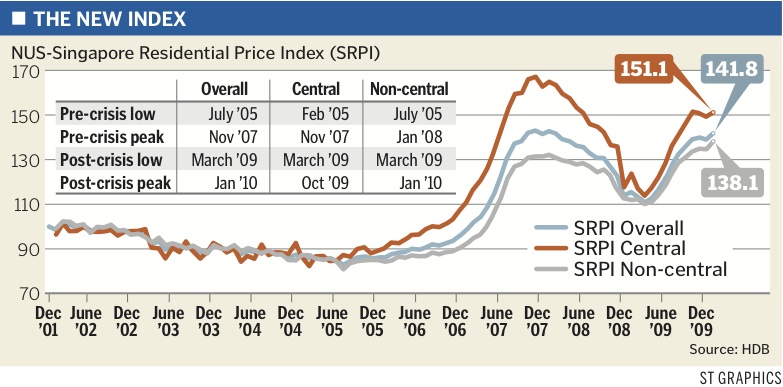
Mr Cheong told the audience at the launch of a new property price index that land values are largely determined by the Government’s reserve price system that features in all state land tenders. Yet a site’s reserve price is not revealed.
‘During periods of high volatility, it is not able to respond quickly enough to real-time changes happening in the marketplace,’ he said.
Mr Cheong, who is also chairman and chief executive of developer SC Global, picked out two recent government land tenders to illustrate the ‘conundrum and the dilemma’ developers face in bidding for such sites.
A single bid for a Tampines site was rejected in June 2008 for being too low but was awarded in March at $421 per sq ft per plot ratio (psf ppr), or 3.6 times higher.
A Ten Mile Junction mixed-use site also had a failed bid of $162 psf ppr in April 2008 but went for $437 psf ppr, or 2.7 times higher, in February.
‘Had the two sites (along with other tenders) been awarded back then at ‘market prices’, the current demand-supply mismatch scenario in the residential market may have been more smoothened and price increases for such mass market projects more muted overall,’ said Mr Cheong.
Such a blunt assessment of the supply situation and other factors driving the market buoyancy by a Redas chairman is unusual. Mr Cheong acknowledged as much, saying he had been advised to avoid commenting about the market for fear of it being a sensitive topic. He said public housing has become an important de facto driver of private property prices.
A strong HDB resale market fuelled the ongoing upgrading process and it was the mass-market segment recovery – fuelled by demand from HDB upgraders – that has led the recovery in the general private residential market.
He also addressed private housing affordability and asked whether the state should be so concerned about where private housing prices are heading when it serves only 16.5 per cent of the population.
‘Should it intervene to restrain the rise in property values to make private housing more affordable or should it be left to market forces?’
Affordability is not only influenced by rising values. There is also short-term demand and available supply imbalances or too much credit expansion in the financial system, said Mr Cheong.
‘Someone who uses very little bank borrowings to buy and exit properties is not a speculator in the same sense as one who leverages aggressively… As we see it, buying what you cannot afford is speculation,’ he added.
Signs of heightened speculative activity were part of the reasons for the Government to introduce measures last September to cool the market. It came out with further steps in February.
‘But what or how much buying is considered excessive? Is it measured by volume, value or quantum? Should the market be left on its own to decide?’ asked Mr Cheong.
The continued buoyancy is caused by various factors such as high liquidity, the upsurge in population and foreign buying.
The pent-up demand in the early phase of economic recovery in mass-market housing, for example, was interrupted by the global financial crisis and never ran its course in the last property cycle, he said.
‘Is it any wonder, then, that the recent measures to cool the private property market did not quench the appetite of genuine home buyers and investors?’
Mr Cheong added that the new price index will hopefully be ‘a step towards improving market transparency and help lessen future needs for frequent market interventions, allowing a freer hand for market forces to work out its own genius’.
Source : Straits Times – 25 Mar 2010


 Lush Dream Home