
Upgrading quality of stock crucial for S’pore’s status as financial hub: JLL
As of December last year, only 9 per cent of Singapore’s CBD office buildings had floor plates of over 20,000 sq ft, which are favoured by big occupiers, particularly financial institutions.
 In Raffles Place and the New Downtown (Singapore’s financial district) alone, only 13 per cent of buildings have floor plates in excess of 20,000 sq ft, according to a Jones Lang LaSalle white paper titled Future Proofing Singapore’s Office Market.
However, the new supply of offices being built presents a great opportunity to enhance the quality of Singapore’s office stock to meet the requirements of financial occupiers, not just in terms of bigger floor plates but also technological specifications, security requirements, catering to lifestyle needs of office workers as well as to address sustainability issues.
The white paper, authored by the property consulting group’s regional director and head of markets Chris Archibold, says: ‘Singapore’s CBD currently only has 3.5 million sq ft of Grade A space with floor plates of at least 18,000 sq ft.
‘The upcoming supply will increase this to about 10 million sq ft by 2012 and enhance the quality of office stock offered in the market. This amount of space is needed to house Singapore’s financial occupiers,’ says the white paper.
Currently financial institutions occupy 83 per cent of international grade A office space in Singapore; hence addressing their requirements is critical if Singapore is to position itself as a major global financial hub.
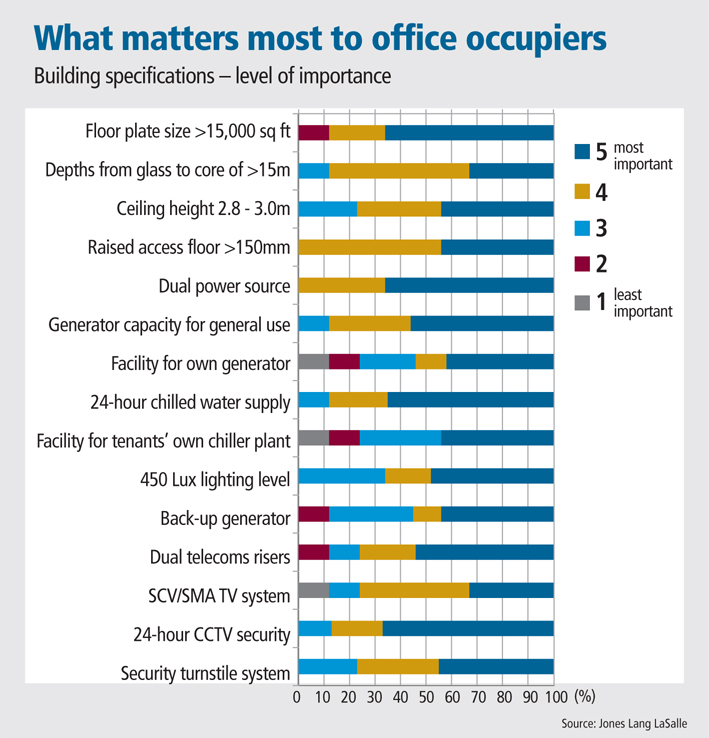
More than 60 per cent of occupiers in JLL’s recent survey viewed floor plates of over 15,000 sq ft at the top of the scale in terms of importance when considering future space. Other key considerations included 24-hour chilled water supply (for air conditioning), dual power source and generator capacity for general use, and security issues.
Unfortunately, much of the island’s existing office stock now is not in sync with the needs of modern MNCs, especially those in the financial industry.
JLL said that besides large floor plates, most occupiers are also looking for modern square or rectangular floor plates with raised floors (to facilitate cabling) and the latest technological infrastructure.
But much of the current CBD office stock does not match this need because the bulk of the current office stock was built prior to today’s technology.
As of December 2009, 68 per cent of the CBD office buildings were more than 11 years old. In Raffles Place and New Downtown, the proportion of office blocks over 11 years old was 62 per cent.
‘This demonstrates that much of the existing CBD office stock suffers from functional obsolescence and needs upgrade works and refurbishments,’ JLL said.
The white paper noted that the massive increase in reliance on IT within MNCs, specifically in the financial services industry, over the past 10 years, has left much of the Singapore CBD office stock unable to cope fully with the needs of these occupiers.
‘Major banks and trading houses are looking for functional buildings with infrastructure that supports business growth and reduces occupational costs.’
These include telecoms infrastructure, multiple telecom providers and fibre-optic network options, open and flexible space, back-up power supplies, a high floor-load capacity, a high floor-to-ceiling height, raised floors as well as large, regular-shaped floor plates.
The shape, size and layout of a building’s floor plates will affect efficiencies. For instance, a regular (square or rectangle) shaped floor, especially if it is built with modern system furniture, will minimise space wastage.
A building with bigger column-free floor plates similarly allows for higher occupational density and minimises circulation areas like corridors.
Besides physical considerations, occupiers also weigh a building’s technical specs in evaluating their choice of premises.
Buildings designed with the occupier in mind substantially reduce upfront fitting-out capital expenditure costs and reinstatement costs at the end of the lease by providing infrastructure such as water supply to each floor (for internal pantries or extra washrooms) and knock-out panels for internal staircases.
JLL also highlighted that with the growing focus on corporate social responsibility, occupiers that are currently considering new premises are looking for environment-friendly buildings to minimise their carbon footprint.
‘Most of the older buildings are very expensive to retrofit with environmentally friendly or sustainable building systems and infrastructure.
‘Meanwhile many new developments are now focusing on attaining either the Singapore Building & Construction Authority (BCA) Green Mark or the US Leed – with some even getting both.’
Source : Business Times – 2 Mar 2010


 Lush Dream Home