
Lessons at one-north include the study of literature, how to build a digital game and cookery classes
IT’S a place where you can study Confucius and Shakespeare, learn how to build a digital game for the Wii, probe the human gene or whip up a Mexican meal – whichever takes your fancy.
one-north, a fast-developing area that wants to be known as Singapore’s ‘icon of the knowledge economy’, is teeming with schools and institutions of learning.
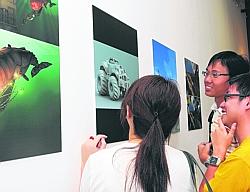
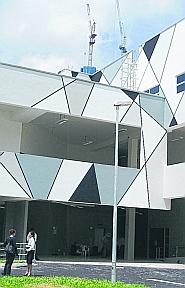 Learning centre: (Left) The Pixel building boasts a funky grey, black and white harlequin-patterned exterior; NTU@one-north houses the Centre for Continuing Education, the Confucius Institute and an alumni clubhouse; aspiring future game developers admiring works of art by DigiPen students
The list includes well-known names in both local and international education – the National University of Singapore (NUS), the Nanyang Technological University (NTU) one-north campus, Insead, DigiPen Institute of Technology, Singapore Polytechnic, United World College, Tanglin Trust School, the Anglo-Chinese School and Junior College and the Japanese Primary School.
Not forgetting the various institutes in genomics, molecular biology and nanotechnology that are housed in giant research centre Biopolis, as well as much smaller outfits that focus on creative pursuits such as drama and cuisine.
‘The location at one-north provides an ideal setting for students, staff and visitors to learn, work and unwind alongside scientists, researchers, technopreneurs and business people from all over the world,’ said a spokesperson for NTU.
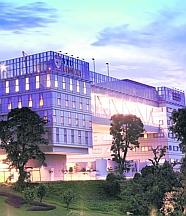 The Jurong-based university last year opened NTU@one-north, which houses educational facilities such as the Centre for Continuing Education (CCE) and the Confucius Institute, as well as a 10-level alumni clubhouse.
The CCE offers executive programmes and online courses for participants in Singapore and abroad. The Confucius Institute, a collaboration with Shandong University and the Office of Chinese Language Council International (Hanban), teaches Chinese and runs courses on Chinese culture.
Different cup of tea
Offering a rather different cup of cha is DigiPen Institute of Technology, which from September will offer two degrees in Singapore – a Bachelor of Science in Real-Time Interactive Simulation and a Bachelor of Fine Arts in Production Animation.
The first degree focuses on the technology behind the development of video games, including the development of game engines, graphics, physics, artificial intelligence and networking. The second degree aims to prepare students to produce 2D and 3D art for animation industries such as feature films and video games.
 The institute is housed in Pixel, a funky grey, black and white harlequin-patterned building at Central Exchange Green, a grassy area in one-north. Jason Chu, chief operating officer for DigiPen, said that the atmosphere there is ‘dynamic, exciting and desirable’.
‘DigiPen’s programmes are exciting and challenging and students need an environment where they can focus and concentrate their efforts in studying,’ he said. ‘The location in Pixel is serene and provides an ideal learning environment.’
DigiPen actually started life in 1988 as Digipen Corporation, a computer simulation and animation company in Canada. In 1998, DigiPen Institute of Technology was created in the US, and its American alumni includes Kim Swift, who ranked seventh in a recent list of the top 25 most influential people in the digital gaming industry. She helped to develop the Portal game for Valve Corporation, which won Best Game of the Year award in 2008.
Mr Chu said that one of the reasons why DigiPen decided to open its first-ever branch campus in Singapore was ‘the dedication and support of the Singapore government towards the development of the interactive digital media industry (IDM)’. Singapore also has ‘the potential of becoming the centre for the IDM industry, due to its strategic location in South-east Asia’, he said.
For Narayan Pant, the dean of executive education at Insead, the nation’s cosmopolitan nature was also a draw for the world-famous business school, which also has campuses in Fontainebleau and Abu Dhabi. ‘Singapore is a cosmopolitan culture and this is a reflection of our own cosmopolitan roots,’ he said. ‘We get students, teachers and participants from all over the world. It’s not only about bringing the class to the world, but about bringing the world to the class.’
Insead’s campus at one-north opened in 2000, and the school had initially planned its next step of expansion for 2008. ‘Instead, our next stage of growth was in 2005, when we had to make a 50 per cent expansion in space,’ said Prof Pant.
The business school’s proximity to other institutions of learning and research is another plus point. ‘In education, you don’t work alone,’ he said. ‘You work in an ecosystem. It’s about being near a library, the NUS, the NTU. And every new development, such as at Rochester Park or Fusionopolis, adds to the ecosystem. From that perspective, one-north is a great place to be.’
Another school which a multi-national flavour, this time literally, is Palate Sensations. The school, situated in a black-and-white colonial building at the Wessex Estate, offers lessons in French, Italian and Mexican cuisine, as well as courses for cocktails and pastry.
‘We like to work some of our courses around a theme, like a movie,’ said managing director and owner Lynette Foo. ‘We have Mexican cooking classes built around Like Water for Chocolate, and French classes around the movies Ratatouille and Chocolat.’
A few blocks away, also in the Wessex Estate within one-north, is the Centre Stage School of the Arts, which teaches drama to children. On any given day, crowds of kids can be seen entering or leaving the school, chattering excitedly and getting ready to enact scenes from Roald Dahl’s The Twits or Shakespeare’s A Midsummer Night’s Dream.
The school accepts participants as young as six months, when babies start to learn the basics of interaction, to as old as 17 years. It also has a few adult classes. ‘Theatre’s so important, it’s not only about acting, but about poise, expression, listening and language,’ said artistic director Peter Hodgson, who has a bachelor of arts in theatre as well as teaching and acting diplomas.
‘More and more, the corporate world is also tending to hire people with an arts background,’ added Mr Hodgson, who started the school with his wife, Alison Tompkins.
Centre Stage used to be located in the River Valley area, but Mr Hodgson said that Wessex Estate, in the green enclave of one-north, is more conducive to learning drama. ‘The advantage here is that we have a beautiful, calm environment,’ he said. ‘It’s more helpful to what we do.’
Source : Business Times – 10 June 2008


 Lush Dream Home