
It will have centres for interactive digital media, computer-generated imagery, games, animation and more
IMAGINE flashing billboards, colourful media screens, film shootings on the streets and red carpet activities galore. This is not downtown Manhattan nor Tokyo. Come 2020, Singapore’s very own Mediapolis may be home to a vibrant suite of film, television and animation clusters.
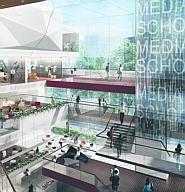
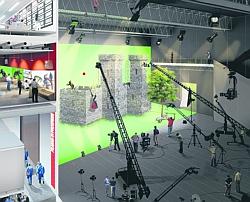 The 19-hectare Mediapolis is set to become a self-contained media ecosystem comprising soundstages (left) with green screen capabilities, digital production and broadcast facilities and media schools (next).
Of course, Mediapolis will not replicate the street scenes of these cities entirely. Internationally renowned architect Bernard Tschumi was clear that he wanted to preserve Singapore’s tropical uniqueness even as he brought in elements from these cities.
And distinct the Mediapolis will be. Mr Tschumi’s works are commonly associated with a post-modern form of architecture called deconstructivism, where buildings take on non-rectilinear shapes or non-uniform surfaces to stimulate a sense of controlled chaos.
He has also introduced this concept to the Mediapolis masterplan – sides of buildings facing the central street will have glass facades and billboards, while the other sides will have to be constructed with other types of material such as steel or wood to create a contrast.
For a project that involved so much creative effort, what exactly is the Mediapolis?
What the Mediapolis is
Located in one-north, the 19-hectare Mediapolis was launched in December last year. It is set to become a self-contained media ecosystem comprising soundstages with green screen capabilities, digital production and broadcast facilities and media schools.
There will also be centres for activities in interactive digital media and research and development; computer-generated imagery and visual effects; games and animation; and intellectual property creation and digital rights management.
Mediapolis was created in response to Singapore’s expanding media sector. In 2005, it reported an annual turnover of $18.2 billion, contributing $4.9 billion value added to the country’s GDP. It also employed close to 55,000 people.
Media funding has also grown with about $1 billion anchored here. Award-winning films, games and animation and major international co-productions such as the filming and production of Mark Burnett’s Contender Asia and The Contender 4 also took place in Singapore.
Global media giants such as Lucasfilm, Linden Lab, EA, Ubisoft and Rainbow SpA have also set foot here. And more media activities such as the upcoming shoot of Jan de Bont’s Point Break 2 will take place this year.
The government therefore came up with Mediapolis to position Singapore as a media hub. Four agencies – JTC Corporation, the Media Development Authority (MDA), the Infocomm Development Authority (IDA) and the Economic Development Board (EDB) – were involved.
 ‘JTC is pleased to be part of this multi-government agency effort that propels Singapore ahead as a trusted global media capital,’ said Philip Su, JTC’s assistant chief executive. ‘We are glad to contribute to building the critical pieces, which will complement each other in the growth of a vibrant media ecosystem.’
JTC is also the master developer of one-north. The Mediapolis will be the third strategic industry cluster in one-north, after Biopolis (biomedical sciences) and Fusionopolis (infocomm, media, engineering and physical sciences).
‘Mediapolis will also be able to leverage on the creative community in the neighbouring Wessex Estate, and tap on the synergies and world-class expertise within one-north,’ said Mr Su.
MDA chief executive Christopher Chia also expressed great hopes for the Mediapolis. It is ‘an essential piece of a comprehensive media ecosystem that we are building’, he said. ‘Over the years, Singapore’s media industry has made great strides, particularly in media financing and international co-productions. To elevate ourselves to the next level, we are finding ways to add scale and synergy to what we already have.’
The government also consulted an International Advisory Committee in the conceptualisation of Mediapolis. The panel comprised media industry insiders such as Dune Entertainment chairman and chief executive Greg Coote, Warner Brothers Pictures president of physical productions Steve Papazian, and film maker and director Shekhar Kapur.
Mediapolis will be developed in two phases. For phase one, JTC has reserved a 1.2-hectare plot of land for works to begin in the first quarter of this year. Local media production company Infinite Frameworks (IFW) will invest in and develop a soundstage complex here.
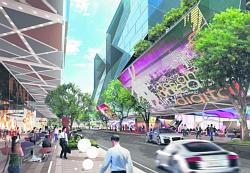 Controlled chaos: Street-facing sides of buildings will have glass facades and multi-media awnings, while the other sides will be built with other materials for contrast
Cutting edge
IFW is a producer of cutting-edge computer graphics and visual effects for television and feature films. The complex is expected to cost $80 million to $120 million and could house three soundstages when completed in two years.
‘The soundstage at Mediapolis presents a unique opening for Infinite to further augment our distinctive range of specialist services for the film and television industries,’ said IFW managing director Mike Wiluan.
The second part of phase one’s development would start after Ayer Rajah Camp relocates in 2011 and could be completed in 2020 at the latest. No date has been set for works on phase two to begin.
The entire Mediapolis could take as long as 20 to 30 years to complete. According to Chan Yeng Kit, permanent secretary at the Ministry of Information, Communications and the Arts, the speed of development will depend on demand from the media industry.
Source : Business Times – 10 March 2009


 Lush Dream Home