Tag Archives: Market Report

Office market here is still active

The vacancy rate in prime Grade A buildings rose from 1.8% in Q3 2008 to 6.1% in Q2 this year

THE office market here, like many around the world, has seen a fundamental shift in dynamics over the last nine months, with a marked drop in demand since the collapse of Lehman Brothers a year ago leading to a drop in rents. While all markets are cyclical, Singapore’s commercial property market has seen rental fluctuations that are typical of a more volatile market such as Hong Kong.
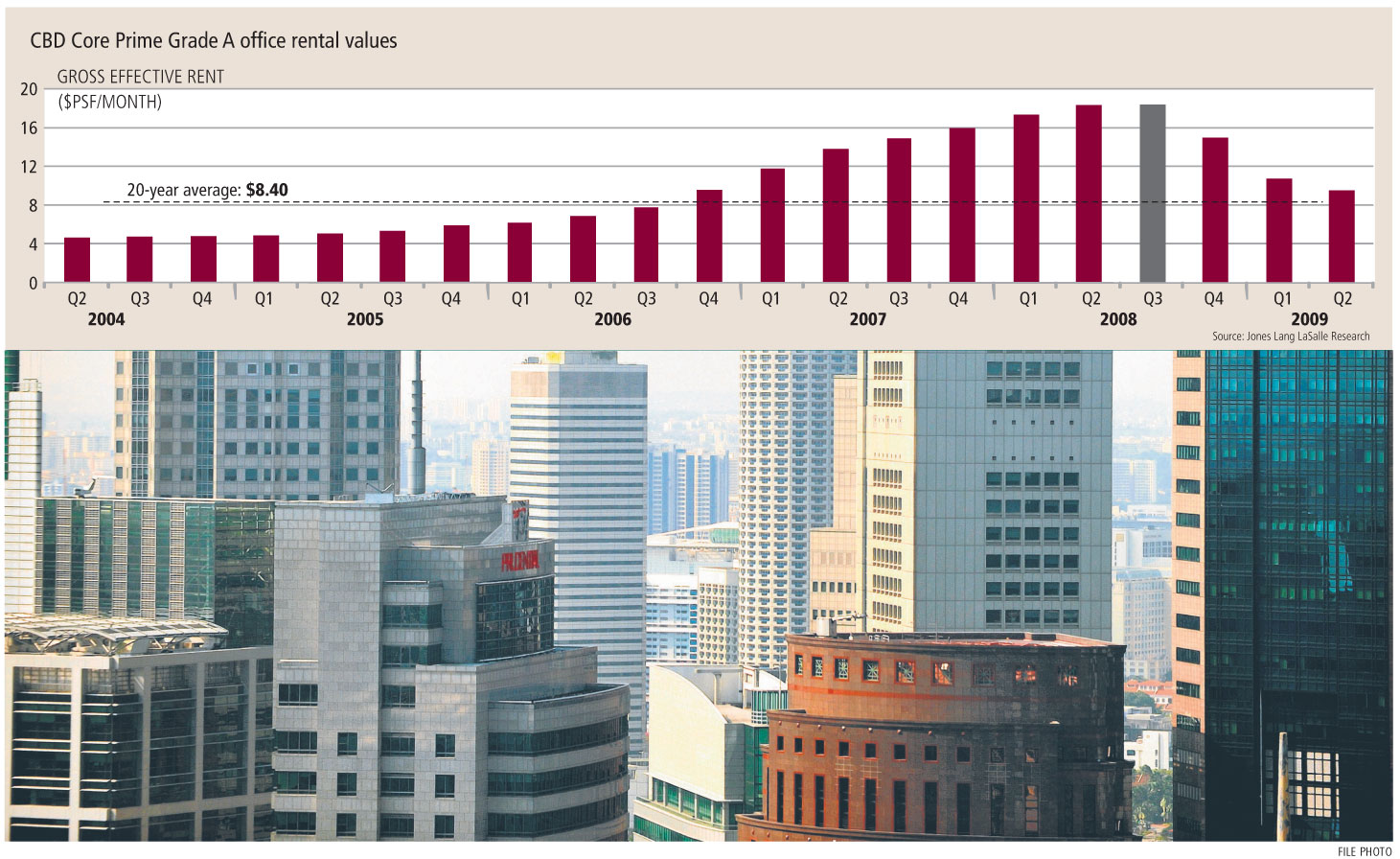
The reason for this is that many new developments were cancelled or delayed during the Asian financial crisis/Sars period in 2002-2004. The typical four-year construction period for a Grade A office building means that there is a lag in the supply pipeline, which was adversely affected from 2006-2008.

These were the years which saw a substantial increase in demand for office space. Much of it came from the financial services sector, partly as a result of the global growth of this sector and partly as a result of Singapore’s successful repositioning as a global financial services centre.

Jones Lang LaSalle’s research shows that from the bottoming out of the market in 2004 to the peak in Q3 2008, Grade A core CBD vacancy shrank from 11.6 per cent to 1.8 per cent and rents surged by 303 per cent. Post credit crisis, the negative take-up and concerns of over-supply have led to rents dropping by 48 per cent between Q3 2008 and Q2 2009. Continue reading

Residential market needs a rework

Changing policies as market conditions change reflects pragmatic and adaptive policymaking which should be applauded

THE big picture driver of real estate wherever is the economy. A residential property buyer pays a certain amount for a particular location because he likes to work, live and play there. Should Singapore execute successfully on mega projects like the integrated resorts, improve her infrastructure, grow her economy and become an increasingly important global city, the trend for property prices is up.

Balancing act: Changing policies as market conditions change reflects pragmatic and adaptive policymaking which should be applauded. Moreover, well-timed pre-emptive moves deserve the most kudos. However, perhaps there is a case for adopting a framework where only supply measures change while demand measures remain unchanged

But how fast should prices rise? Is there excessive speculation in the Singapore private residential property market? These are tricky questions and governments everywhere, through their policies, play a major role in impacting the property market. Recently, the Singapore government, acting to pre-empt any speculative bubble from forming, unveiled both supply measures such as reinstating the confirmed list of land sales in the first half of 2010 and demand measures such as disallowing the interest-absorption plan and interest-only loans being offered to buyers of uncompleted private homes.

Changing policies as market conditions change reflects pragmatic and adaptive policymaking which should be applauded. Moreover, well-timed pre-emptive moves deserve the most kudos. However, perhaps there is a case for adopting a framework where only supply measures change while demand measures remain unchanged. This is not just about letting free market forces reign as adopting such a stand creates more certainty for developers and property buyers, both of whom are committing to sizeable investments. Whenever large sums of investment are being made, consistent regulations are called for and the residential property market should be no exception. For example, let’s be clear whether we want schemes like deferred payment or interest absorption all the time, not at all, or some of the time. Continue reading