Tag Archives: Landed Property

Landed homes: Lure of scarcity

With relatively few landed home launches, buyers are always keen on older houses in the resale market, writes HAN HUAN MEI

WHEN private home prices made their sterling recovery in the second half of 2009, landed homes didn’t miss out on the action. The Urban Redevelopment Authority (URA) price indices for detached, semi-detached and terrace houses recovered by 22-26 per cent in 2H 2009, after falling some 18-21 per cent from the market peak in the second quarter of 2008 to Q2 2009.

This upward trend is likely to continue because of the scarcity of landed homes in Singapore. Out of a total housing stock of 1.14 million units, only 69,500 or 6.1 per cent are landed homes.

While new landed projects are limited, home buyers are always willing to buy older properties in the resale market. On average, 380 new landed homes and 2,800 resale landed homes changed hands annually between 2004 and 2009.

Moreover, there is also a certain degree of speculative activity in the landed market. An analysis of the caveats lodged for subsales of new landed properties in the past year shows a gain of 5.5 to 34 per cent from their original prices two to three years ago.

Landed properties offer a certain prestige to homeowners in the middle to high-income groups. Nowadays, well-heeled homebuyers in their mid-30s are especially attracted to entry level bungalows with a land area of 4,000-5,000 sq ft and costing $4-$5 million. Some of these can be found in Lynwood Grove and Cotswold Close.

Equally popular are strata bungalows like Goodman Crest and Bellaville which have the same built-up area as the average bungalow but cost less – around $2.5-$3.5 million – because of the shared ownership of land and communal facilities like swimming pool and landscaped garden.

Similarly, cluster terrace houses are seen as value for money as opposed to condominiums because of their generous built-up areas of over 3,000 sq ft. These also come with communal facilities which appeal to families with young children.

However, the downside of cluster terrace developments is the rather crowded conditions within the compound and the higher volume of vehicular traffic they generate in the neighbourhood.

At the top of the Singapore housing pyramid are the good class bungalows (GCBs) which are the most prestigious and expensive type of housing. In just the first two months of 2010, some 14 GCBs were transacted, compared with just three in the first quarter of 2009.

Among the 14, the most expensive GCB was a Swettenham Road house, which sold for $31.5 million in January. It has a land area of 29,569 sq ft.

In 2009, the highest priced GCB was sold in October at $38.67 million. It is located in Victoria Park Road and has a land area of 32,077 sq ft.

Over at Sentosa Cove, Kasara villas, which range from 9,000 sq ft to over 14,000 sq ft, were sold at $14-$22 million in November 2009. These villas come with designer finishes and top quality fittings.

The reason why leasehold landed homes in Sentosa Cove can fetch prices equivalent to, if not higher than, their freehold counterparts on the mainland is because of the resort island status, foreigners’ eligibility to buy and above all, limited supply of around 400 units. Foreigners are not allowed to buy landed properties on the mainland and even permanent residents need special approval from the authorities to buy one.

In 2009, a landed project in Seletar Hills estate called Luxus Hills was launched. The first phase of 78 terrace houses was sold within a few weeks. In the second phase, another 30 units sold quickly at a similar price range. The terrace houses fetched $1.7-$2 million while the semi-detached houses fetched $2-$2.2 million.

Estrivillas, a cluster housing project in Jalan Lim Tai See comprising 38 semi-detached and one detached house, was launched in November 2009. By January this year, 24 of the 39 units had been sold at $3.5-$3.8 million.

In the resale market, transactions in January and February this year show that the median price of semi-detached and terrace houses was $2.5 million and $1.5 million respectively. A year ago, the corresponding median prices were $1.76 million and $1.16 million.

Developers marketing landed properties should emphasise the limited land resources and hence, the value of landed properties in the long-term. Secondly, owners do not have to pay maintenance fees for houses, unlike condominiums. Unless a house is very old, the upkeep is generally inexpensive. Spending money on one’s own property beats contributing $3,000 to $4,000 a year to a condo management or sinking fund.

Landed homes are also attractive as investments as they can fetch good rentals. Proximity to premier schools, international schools and embassies is definitely an advantage.

At the top, GCBs in Bukit Timah can be leased out at $18,000 to $25,000 a month while standard detached houses can fetch $12,000 to $18,000, depending on their size and condition. Semi-detached houses can command a monthly rent of $8,000 to $12,000 while terrace houses can achieve $3,000 to $7,000.

Limited supply results in the relatively inelastic prices of landed homes, and increasingly, those who hold such properties will find them a boon as more often than not these are assets that appreciate in value over time.

The writer is associate director, CBRE Research

Source : Business Times – 25 Mar 2010

Homes double as hostels for medical tourists

Homes near Orchard Rd hospital found illegally offering budget lodging to patients, travellers

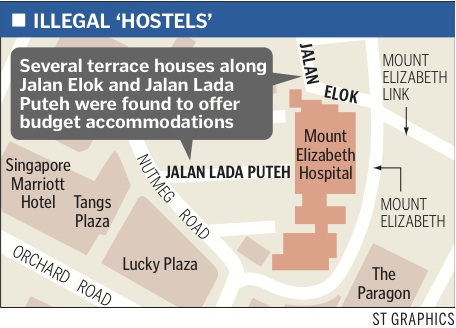
Tourists entering a terrace house along Jalan Elok. At least eight houses within a two-minute walk of Mt Elizabeth Hospital welcome foreigners on a short-term basis for a fee. — ST PHOTO: NG SOR LUAN

SEVERAL terrace house owners in the quiet lanes near Mount Elizabeth Hospital are opening their doors to medical tourists and travellers seeking budget accommodation in the heart of Orchard Road.

They charge between $50 and $120 per room a night, depending on the number of guests and whether it is peak season.

A room in a hotel in that area could cost at least three or four times more. For the price they pay, tenants get a bed, bathroom access, air-conditioning and housekeeping services. Rooms with bathrooms are pricier. These ‘hostels’ are often fronted by the owners’ maids, usually Indonesians, who can communicate better with these overseas patients, many of whom are also Indonesians.

The owners, however, appear to be breaking the Urban Redevelopment Authority’s (URA) rules, which state that private properties cannot be converted to other uses such as workers’ dormitories or boarding houses. The Straits Times found at least eight terrace houses within a two-minute walk of Mount Elizabeth Hospital where foreigners can stay on a short-term basis for a fee.

Most are in Jalan Elok, between the hospital grounds and York Hotel, but there are also a few along Jalan Lada Puteh, which is behind the hospital and next to Lucky Plaza.

On one Tuesday afternoon, The Straits Times spotted a group of six Indonesians dragging their suitcases behind them and entering one of the houses along Jalan Elok. When approached, one said they were in Singapore on vacation and had heard about the lodging from a friend back home. The group booked two rooms for $120 a night.

Moments after the group entered, a woman in a blue sports car pulled up just outside the house. Madam S.L. Chong, 64, identified herself as the owner but said the group who had just walked in were her Indonesian husband’s relatives.

The housewife said she charged them a minimal fee, as she was ‘unemployed and needed to make a living’. She claimed that she had approval from the URA to do this.

However, a check with the authority showed that this was not true. Its spokesman said it would investigate the possible infringement. The URA usually issues a warning notice to offenders and, if the unauthorised use does not stop, they can be charged in court and face fines of up to $200,000 or jail of up to a year, or both.

Two doors away from Madam Chong’s house, Madam Lily Lim told a similar story – that those staying temporarily in her house were her in-laws from Indonesia.

However, when The Straits Times contacted Madam Lim as an interested customer to inquire about lodging, she offered a room in her house at $50 a day.

When asked about this, Madam Lim insisted these rates were only for her relatives and said she did not require government approval for this.

Like Madam Chong, she said she could not afford to house them for free.

Business appears brisk at these ‘hostels’. The housekeepers of two of such houses said all their six bedrooms were fully occupied, for the next eight days for one of them.

A 47-year-old Indonesian businessman who has helped friends book accommodation at these houses said that, during the Formula One race season or other peak periods, these ‘hostels’ charged almost double the usual rates to cash in on the hotter demand.

Two houses at Jalan Elok even had an additional room built in the parking space, he said. It is understood that some houses have also repartitioned their bedrooms. ‘You can tell; some of the walls sound hollow,’ said the businessman.

Unauthorised repartitioning with the purpose of operating a boarding house is also illegal, said the URA.

Some of the owners of these terrace houses do not even live there, said other Jalan Elok residents. Indonesian housekeepers, allegedly employed as maids, are left in charge of a host of additional responsibilities such as providing housekeeping services to tenants.

Such accommodation, though illegal, do cater to the need for affordable short-term stays, filling a gap between hotels and hostels, which are usually run-down.

Several guests The Straits Times approached said they were in Singapore either to seek medical help or to visit relatives in hospital. Some were private students from countries such as Vietnam and China.

Mr Jim Chen, 40, a tenant from the Philippines, ditched his initial plans of staying at a serviced apartment at the nearby Lucky Plaza because it was ‘just too crowded and too noisy’. The fitness centre manager, who is in Singapore for physiotherapy, settled for a room in a Jalan Elok house, where he found the environment more tranquil.

An Indonesian maid, who gave her name as Madam Kartini and who advertises a house on Jalan Lada Puteh with rooms for rent on a website, said: ‘Most of them are here for medical treatments. We rarely have tourists.’

She added that most patients and their relatives stayed for a couple of days but some, such as cancer patients undergoing chemotherapy, would stay much longer, sometimes for more than a month.

Apart from the convenient distance from one of the region’s largest private hospitals, the main draw of these ‘hostels’ is their affordability. ‘Medical expenses are already so costly, and everything else in Singapore is also very expensive,’ said Madam Kartini. ‘At least they can now save on lodging.’

A hotel room in this prime area goes for between $200 and $600 a night.

Some residents in the area, though, are unhappy.

A resident in her 30s, who declined to be named, is disturbed by how such businesses have ’spoilt the neighbourhood’. She complained of shady characters. ‘It is no longer the case where I can let my son play outside,’ she added.

Mr Woo Chan Joo, a 77-year-old retiree, lives across a house where rooms used to be rented out until a fire there two months ago put an end to that. He said: ‘There were many people coming and going, some of them were in wheelchairs, some bandaged… It’s more peaceful now.’

Source : Straits Times – 8 Mar 2010