Tag Archives: HDB News

HDB flats: Facts & Myths

NATIONAL Development Minister Mah Bow Tan spent some time in Parliament yesterday addressing popular misconceptions about Singapore’s public housing market.

MYTH: There are not enough HDB flats to meet demand.

HIS RESPONSE:

The HDB released 13,500 new flats last year and will release another 12,000 or more this year. This is more than the total number of flats in Clementi or Jurong East (about 23,000 flats each).

The massive oversubscription rates for new flats are misleading. That is because half the number of flat applicants choose not to book a flat when invited to do so. Many say this is because they could not get a flat of their choice, yet in recent selection exercises, one-third rejected flats on the first day of selection, when all the flats were available.

Some first-time buyers have complained that they have tried repeatedly to get a flat to no avail. But when the HDB reviewed 477 such cases in the last six months, it found only 29 appeals (6 per cent) were genuine.

CASE STUDY: Mr C complained about his lack of success in getting a flat. The HDB’s checks found that he had submitted four applications, three of which were in highly popular mature estates. In six months, he consecutively rejected three offers of flats: one offer of 121 flats in Punggol/Sengkang because he had been ‘targeting a unit in Buangkok’; another offer of 143 flats in Punggol because ‘the units left are facing the mosque’; and a third offer of 14 flats in Serangoon, Yishun, Ang Mo Kio, Tampines and Woodlands because these were not his ‘choice’ flats.

MYTH: HDB flats are unaffordable.

HIS RESPONSE:

On top of the CPF Housing Grant of $30,000 or $40,000, there is an Additional Housing Grant (AHG) for lower-income families of up to $40,000. As of Jan 31, the Government disbursed more than $330 million in AHG to more than 20,000 families.

The median house price is 5.8 times the median household income in Singapore. In comparison, the ratio is 7.1 in London and 19.8 in Hong Kong.

The average mortgage payment for new flats in non-mature estates sold in 2009 was 22 per cent of monthly household income. This is well below the affordability benchmark of 30 per cent to 35 per cent.

Four out of five Singaporean new flat buyers service their housing loans from CPF savings, without any cash payment.

CASE STUDY: Mr and Mrs S, with a $4,500 monthly income, bought a four-room flat in Punggol for $297,900. They received $10,000 in grants and took a concessionary loan of $268,100 (90 per cent of the price) from the HDB. The couple’s monthly instalment is $1,073, or 24 per cent of their income. They can use $1,035 from the CPF to service the mortgage and end up paying only $38 monthly in cash.

MYTH: PRs push up prices.

HIS RESPONSE:

The median cash-over-valuation (COV) paid by permanent residents have been the same as the median COV nationwide for the last two quarters.

Cases of PRs paying high COV are the exception. Of 37,205 resale transactions in 2009, 58 cases had COV exceeding $70,000. Of this, only eight (14 per cent) involved PRs.

MYTH: Private property owners push up prices.

HIS RESPONSE:

Their number is not large enough to push up prices. Of the 58 resale transactions last year with COV exceeding $70,000, only 11 cases (19 per cent) involved private property owners.

MYTH: Subletting of HDB flats is rampant.

HIS RESPONSE:

Of the 682,000 flats that have fulfilled current Minimum Occupation Period requirements, only 3 per cent are sublet. This suggests most flat owners are buying their flats for occupation, and not rental.

Source : Straits Times – 6 Mar 2010
HDB rules change

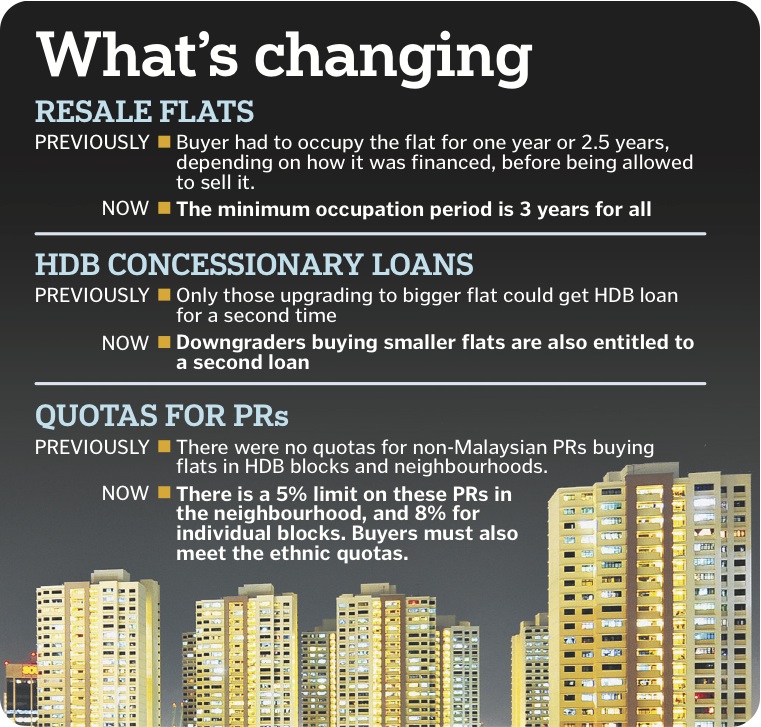
BUYERS of non-subsidised HDB resale flats must now occupy their flats for at least three years before they can sell, under new rules unveiled yesterday.

This is up from 2-1/2 years for buyers with HDB loans and one year for buyers with bank loans or no loan.

The move, effective yesterday, is seen as a government effort to curb speculative buying and selling of public housing.

Home hunters have expressed dismay in recent months that speculators may be pushing up HDB resale flat prices.

Property consultants said the move is set to nip speculation in the bud but is not likely to result in lower flat prices.

The move comes after an HDB study found that a growing number of flat owners were selling flats within three years.

In late January, National Development Minister Mah Bow Tan flagged a review by HDB of its rules, with a view to stamping out possible speculation.

In Parliament yesterday, Mr Mah said said more flat owners had been selling flats as soon as the minimum period was up, although the numbers were not large.

He added: ‘However, if the trend continues, buyers who genuinely need housing could be crowded out.’

He was responding to MP Ang Mong Seng’s request for a review of the one-year minimum period applying to those with bank loans or no loan.

‘HDB flats are provided primarily for owner-occupation and not speculative profit or rental return,’ said Mr Mah.

HDB said in a statement that the change meant demand would more accurately reflect interest from buyers who wish to occupy flats.

Different rules apply to subsidised buyers who receive HDB grants.

Home hunter Sofian Buang, 33, a loading officer, said: ‘My biggest concern is getting a roof for my family, now that I have a daughter. I am looking for a resale flat to settle in, not to sell or to rent out.’

ERA Asia-Pacific associate director Eugene Lim said the change would remove buyers who wanted to flip HDB flats after a year. ‘With a smaller group chasing after HDB resale flats, price increases will slow down,’ he said.

Demand for resale flats outweighs supply so prices will still rise, but perhaps at a slower pace, said C&H Realty managing director Albert Lu.

Mr Steven Tan, executive director of OrangeTee’s residential division, said the change would cut speculation but that the Government should look at private property owners buying HDB flats to rent out right away.

If demand is growing and fewer people choose to sell because they want to lease their flats out, prices will rise, he said.

Mr Mah said that of the 682,000 flats that are eligible for subletting, only 3 per cent are sublet, suggesting that most flat owners are buying their flats for occupation, and not rental.

Amid concerns of runaway HDB prices, other MPs yesterday raised questions, including a possible ban on some buyers.

‘There is a populist suggestion that we should ban private property owners from buying HDB flats,’ said Mr Mah. But if the Government did so, what about HDB owners buying private property, he said.

Most resale flat buyers are citizens who do not own any private property, he said, adding that there was no evidence that specific buyer groups, like PRs and private property owners, were driving up prices.

He said buyers who did not want to pay very high prices could walk away.

Some other key changes unveiled yesterday include allowing upgraders and those who downsize to apply for a second concessionary HDB loan. This could push up resale activity for smaller flats in the resale market, said PropNex chief executive Mohamed Ismail.

The HDB study found that last year, 9 per cent or nearly one in 10 resale flats sold had been owned for under three years. Between 2005 and 2007, the figure was just 6 per cent of sales.

Source : Straits Times – 6 Mar 2010