Fusionopolis’ towers house scientists and engineers working on new medical solutions and technical innovations
DRIVING past Buona Vista it is hard to miss the futuristic towers that make up the first phase of Fusionopolis. Connected by a podium, the 24-storey Symbiosis and 22-storey Connexis reflect the daylight off their glass facades like gems, while the red circular logo at the top of one-north glows like a beacon in the night.
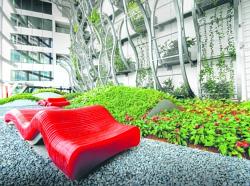
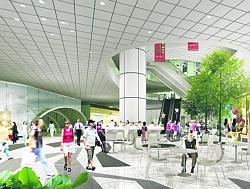
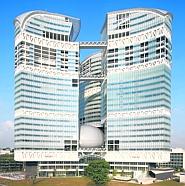 Research hub: (From above onwards) The Fusionopolis towers, one of the 13 sky gardens spread throughout the two towers, and the retail space. Fusionopolis aims to create an environment that is conducive to research, especially for the infocomm, media, science and engineering industries to incubate and test-bed ideas and products, says JTC. This, in turn, will create jobs and IP rights for Singapore
But these buildings amount to much more than architectural beauty. Officially launched on Oct 17 last year, they have become home to a scientific community of talent working hard on the next technical innovation or medical solution.
As JTC Corporation’s assistant chief executive Philip Su explains, Fusionopolis aims to create an environment that is conducive to research, especially for the infocommunications, media, science and engineering industries to incubate and test-bed ideas and products. This, in turn, will create jobs and intellectual property (IP) rights for Singapore.
JTC is the master developer of one-north, the research and development (R&D) centre in the west that includes Fusionopolis, a project that has come a long way since construction began in 2003 amid the Sars outbreak.
 Mr Su says JTC believes in the development’s long-term potential and went ahead with it even though market confidence was low at the time. The take-up rate since has been overwhelming. ‘Now I’ve got a problem,’ he says. ‘I don’t have enough space.’
Attractive co-location
Costing $560 million, Fusionopolis’s 120,000-square-metre phase 1 development already houses various public and private research institutes – co-location that is attractive because it promotes collaboration and the exchange of ideas.
Private tenants include Panasonic Electric Works Asia-Pacific, Seiko Instruments, Thales Technology Centre (S) and Vestas Technology R&D.
A*Star’s Science & Engineering Research Council (Serc), the Media Development Authority and Spring Singapore are also there.
And the University of Illinois at Urbana-Champaign will set up its first overseas research centre at Fusionopolis. It will run a five-year programme to study how humans can interact with the digital world as seamlessly as they do with their natural five senses – an example of new frontier research called the human sixth sense programme.
 Indeed, Fusionopolis could well re-invent the way research is done, by bringing cross-disciplinary capabilities under one roof to find solutions to global challenges.
Such collaboration is already going on for treatment of attention deficit hyperactivity disorder (ADHD) – a disorder that causes children to be disruptive and makes it hard for them to concentrate and learn.
A*Star’s Institute for Infocomm Research, the Duke-NUS Graduate Medical School and the Institute of Mental Health are working on non-invasive therapy that helps people concentrate. They have come up with a game that could teach children with ADHD to focus, and perhaps to pay more attention to their teachers.
‘Creating this technology requires a multi-disciplinary team – it takes the expertise, experience and creativity of many individuals to identify the problem, develop a solution and the technologies to implement it,’ Science and Engineering Research Council chairman Charles Zukoski said last year. ‘It is solving problems in this manner that will epitomise the work conducted at Fusionopolis.’
To facilitate interaction, the first phase of Fusionopolis also integrates various live, play and learn elements for the 800 or so scientists, engineers and game developers working there.
Shopping and entertainment
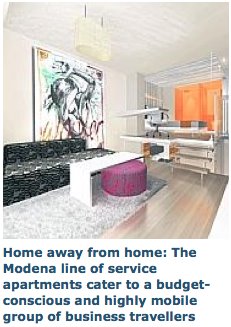
Some reside comfortably in the 50 serviced apartments on the 17th to 19th floors of the Symbiosis tower after work. Managed by Frasers Hospitality, each unit is about 60 sq m.
There are also retail and food and beverage outlets such as Starbucks Coffee and Harry’s Bistro and Bar. In line with the Fusionopolis vision, Cold Storage is even test-bedding ideas at the Market Place @ one-north. The supermarket is equipped with digital price tags and trolleys fitted with LCD screens that feature the latest promotions.
Staff looking to take a break from all the heavy research can retreat to one of the 13 sky gardens spread throughout the two towers. Some include ponds and water wells in the landscaping, and one may even screen out telecommunications signals in future for visitors to enjoy undisturbed peace.
Beyond beautifying the environment, the sky gardens also help diffuse heat from the buildings and create energy savings.
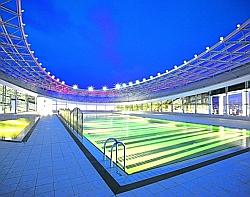 Relaxation: The open-air swimming pool at Fitness First, a gymnasium situated on top of the Connexis tower of Fusionopolis
For those who prefer exercise as a way to unwind, there is Fitness First. The gymnasium has an open-air swimming pool and is situated on the top-most floors of the Connexis tower.
There is even a black-box theatre to bring the arts into the scientific community. Nestled between the two towers, the Genexis theatre has more than 500 retractable seats and the space can be easily configured to accommodate conferences, exhibitions and various other events.
With all these features, phase 1 of Fusionopolis can pride itself as the first high-density mixed-use development in one-north. Activity in the area is set to mount once phases 2A and 2B take shape.
The $600 million phase 2A development will be ready in 2012 and will house various laboratories, test-bedding centres and what could be Singapore’s largest R&D clean room facility across 103,600 sq m of space.
Phase 2B may be up and running in 2011 and will provide up to 50,000 sq m of space for other agencies and companies working with nearby institutes.
And more developments are set to come. The entire Fusionopolis will be a 30 ha complex comprising six phases when it is fully completed, by which time it will be Singapore’s icon for R&D in interactive media, physical sciences, engineering and technology.
Source : Business Times – 24 February 2009



 Lush Dream Home