
The nation avoided the recession that hit most developed countries, says DANIEL BOMAN
AUSTRALIAN residential property prices have been quick to return to growth after the global financial crisis, underpinned by a strong economy and increasing population growth.
Australian capital cities recorded an average of 5.2 per cent growth in dwelling prices over the fourth quarter of 2009, a strong improvement on the 1.3 per cent decrease in the corresponding quarter a year ago.
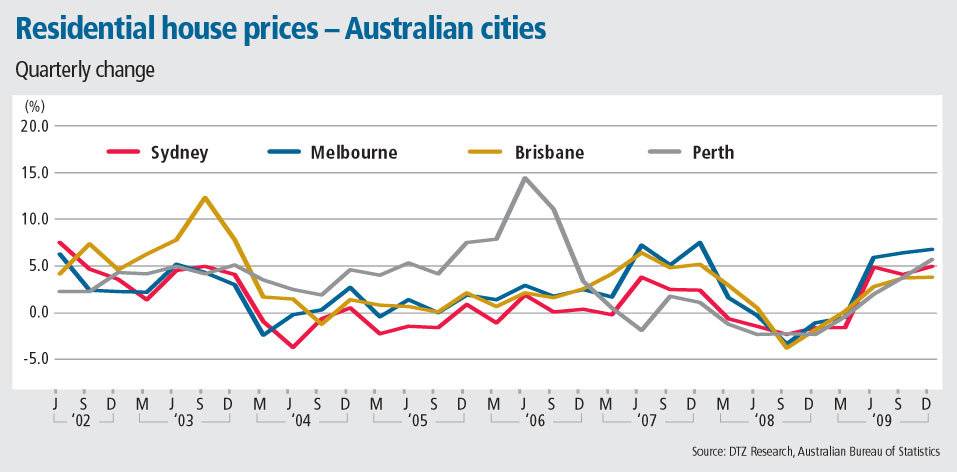 Over the past year, figures from the Australian Bureau of Statistics show house price growth has equated to 13.6 per cent, a strong result that has been buoyed by a strong recovery in consumer confidence and consistently strong economic growth.
Due to its diversified economy, stable political climate and secure banking system, Australia was able to avoid the recession experienced in most of the developed world during 2008/09.
Over the last 12 months Australia’s GDP grew by 2.7 per cent, well above the averages of the G7 countries at -0.9 per cent, the European Union at -2.3 per cent and the US at 0.1 per cent. Economic growth is forecast to continue, with Oxford Economics predicting a further 2.7 per cent growth for 2010 and 4 per cent for 2011.
The strong economic performance is attracting an increasing number of foreign migrants to the country, with a net total of 285,300 persons moving to Australia during the year ended June 2009, up from 213,600 the previous year. Coupled with a strong natural increase of 157,800, the demand for Australian property continues to be underpinned by a need for new dwellings to meet a rising population.
The increase in residential property prices is occurring in all major capital cities in Australia, with the largest city, Sydney, recording price growth of 12.8 per cent over the past year.
The city of Melbourne, located to the south of Sydney recorded the largest increase last year, returning 19.7 per cent, while Brisbane to the north recorded 10.9 per cent.
In the west, Perth recorded 11.5 per cent growth, largely underpinned by the strong performance of the mining sector which comprises a large proportion of the city’s economy.
Due to the lack of bank finance created by the global crisis, the construction of new dwellings has not kept pace with Australia’s strong population growth.
During the year ended June 2009, Australia’s population increased by 443,100 persons. With an average household size of 2.6 persons per dwelling this creates an indicative demand for an additional 170,000 dwellings.
Yet during the same period, only 131,300 new dwellings commenced construction, creating an indicative shortage of 39,000 dwellings. This is expected to place further upward pressure on prices and rents.
On a closing note, it is interesting to note a changing demand in dwelling types by Australian buyers and renters.
In the past, new development has usually taken the form of house-and-land packages located on the outer fringes of major cities, but now development is increasingly focused on inner city apartment developments and smaller lot housing.
In our view, this change is a response to a growing shortage of land in the outer suburbs driving up prices, coupled with a desire of many people to live closer to their workplace and to the inner city restaurants, bars and shopping.
Changing demographics have also increased the proportion of people seeking to rent a property rather than to own, creating opportunities for investors to own low-maintenance inner city units.
Daniel Boman is research manager at DTZ Australia
Source : Business Times – 25 Mar 2010


 Lush Dream Home