Category Archives: Property Market / Real Estate

Resale private home prices unchanged in August: SPRI

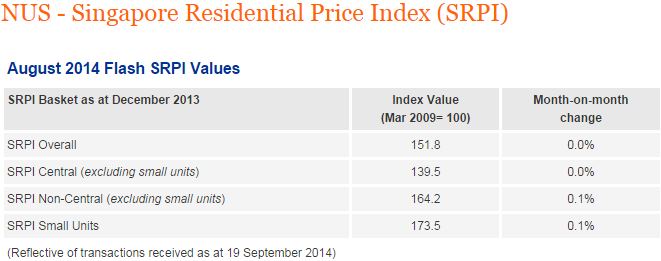
Resale prices of private homes in Singapore remained largely unchanged in August, according to Singapore Residential Price Index (SRPI) flash estimates released on Monday.

Compiled by the National University of Singapore (NUS)’s Institute of Real Estate Studies (IRES), the SRPI showed that overall prices remained flat in August from the previous month, following the revised 0.1 percent increase posted in July.

Prices of homes in the Central region, excluding small units, remained unchanged in August, while home prices in the non-Central region, also excluding small units, rose 0.1 percent.

Prices of small units, or those with floor areas of up to 506 sq ft, climbed 0.1 percent in August from the month earlier.

The Central region sub-basket covers properties located in districts 1 to 4 and 9 to 11, while the non-Central region sub-basket includes properties located in remaining districts.
NUS-Singapore-Residential-Price-Index-SRPI2

S’pore property outlook challenging until 2020

What does the future hold for Singapore’s property market?

According to a recent Savills report, the outlook remains challenging for the rest of 2014, and this is expected to continue over the next six years.

The report looked at how 12 world cities would perform in 2020 and gave a tough assessment of Singapore.

Although the office sector is still robust with rents increasing by 7.3 percent in the first six months of 2014, the residential market has slowed with values and rents dropping by 4.2 percent and 3.5 percent respectively during the period.

This is due to the government’s cooling measures which are continuing to put pressure on the city-state’s prime residential market.

Savills added: “Market controls are set to be a feature of Singapore over the coming years as it battles market affordability in a bid to remain competitive on the global stage.”

One factor that puts Singapore at a disadvantage is its restricted land supply, which is at odds with the increasing wealth and growing workforce.

Lower value industries may have to relocate across the causeway, where land, property and wages are cheaper.

At the same time, Singapore risks becoming more rarefied or distant from the lives and concerns of ordinary people, with Singaporeans protected by government access to housing.

Meanwhile, employers will face more difficulty in attracting and retaining young talent from overseas due to the high real estate costs.

On a positive note, Singapore’s high-tech infrastructure and proximity to some of Asia’s key growth markets will see it progressing as a world leader in business.

In fact, the World Bank has ranked Singapore as number one for ease of doing business.

The city-state also has a strong reputation in the biotech and energy sector.