Category Archives: Overseas Property

Australian property returns to growth

The nation avoided the recession that hit most developed countries, says DANIEL BOMAN

AUSTRALIAN residential property prices have been quick to return to growth after the global financial crisis, underpinned by a strong economy and increasing population growth.

Australian capital cities recorded an average of 5.2 per cent growth in dwelling prices over the fourth quarter of 2009, a strong improvement on the 1.3 per cent decrease in the corresponding quarter a year ago.
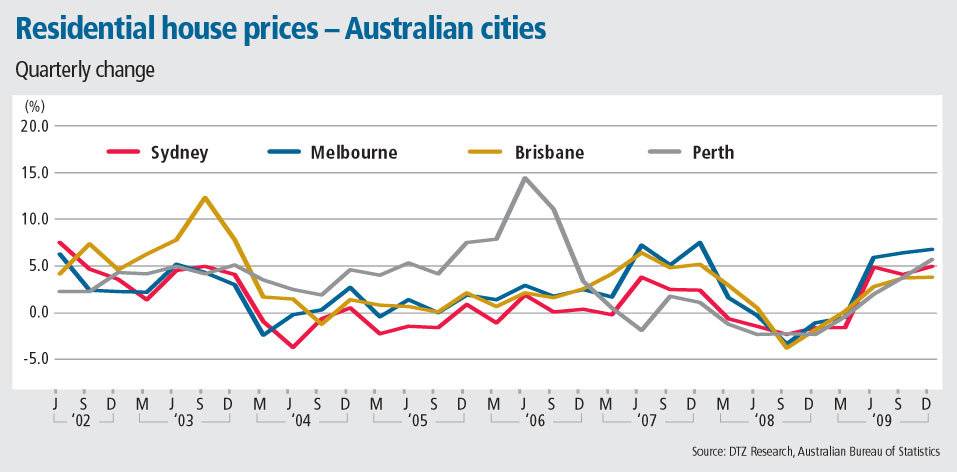
Over the past year, figures from the Australian Bureau of Statistics show house price growth has equated to 13.6 per cent, a strong result that has been buoyed by a strong recovery in consumer confidence and consistently strong economic growth.

Due to its diversified economy, stable political climate and secure banking system, Australia was able to avoid the recession experienced in most of the developed world during 2008/09.

Over the last 12 months Australia’s GDP grew by 2.7 per cent, well above the averages of the G7 countries at -0.9 per cent, the European Union at -2.3 per cent and the US at 0.1 per cent. Economic growth is forecast to continue, with Oxford Economics predicting a further 2.7 per cent growth for 2010 and 4 per cent for 2011.

The strong economic performance is attracting an increasing number of foreign migrants to the country, with a net total of 285,300 persons moving to Australia during the year ended June 2009, up from 213,600 the previous year. Coupled with a strong natural increase of 157,800, the demand for Australian property continues to be underpinned by a need for new dwellings to meet a rising population.

The increase in residential property prices is occurring in all major capital cities in Australia, with the largest city, Sydney, recording price growth of 12.8 per cent over the past year.

The city of Melbourne, located to the south of Sydney recorded the largest increase last year, returning 19.7 per cent, while Brisbane to the north recorded 10.9 per cent.

In the west, Perth recorded 11.5 per cent growth, largely underpinned by the strong performance of the mining sector which comprises a large proportion of the city’s economy.

Due to the lack of bank finance created by the global crisis, the construction of new dwellings has not kept pace with Australia’s strong population growth.

During the year ended June 2009, Australia’s population increased by 443,100 persons. With an average household size of 2.6 persons per dwelling this creates an indicative demand for an additional 170,000 dwellings.

Yet during the same period, only 131,300 new dwellings commenced construction, creating an indicative shortage of 39,000 dwellings. This is expected to place further upward pressure on prices and rents.

On a closing note, it is interesting to note a changing demand in dwelling types by Australian buyers and renters.

In the past, new development has usually taken the form of house-and-land packages located on the outer fringes of major cities, but now development is increasingly focused on inner city apartment developments and smaller lot housing.

In our view, this change is a response to a growing shortage of land in the outer suburbs driving up prices, coupled with a desire of many people to live closer to their workplace and to the inner city restaurants, bars and shopping.

Changing demographics have also increased the proportion of people seeking to rent a property rather than to own, creating opportunities for investors to own low-maintenance inner city units.

Daniel Boman is research manager at DTZ Australia

Source : Business Times – 25 Mar 2010
UK home sector evolving into 2-tier market

NEIL BEHRMANN observes that prime real estate in London outperforms the rest of the country

THE UK residential property sector has become a two-tier market.

Prime real estate in London and the stockbroker belt have outperformed the rest of the country by a wide margin in the past year. Wealthy foreign buyers taking advantage of a cheap pound, the stock market recovery and banker, broker and trader bonuses are behind the revival. Much lower mortgage rates have also helped over-stretched property owners, enabling them to hang on to their pricey properties. There were thus less forced sales than expected. The supply of properties declined and this has played a part in pushing up prices.

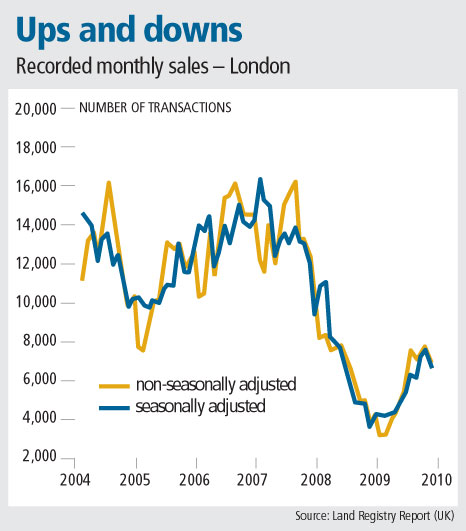
The result is that after the property bubble in 2006 to 2007 and the crash in 2008, prices of selected residential properties, especially prime London, jumped in the past year.

The chart from the Royal Institute of Chartered Surveyors describes what has happened in the UK. Despite the revival, however, average residential property values are still well below their peaks and so far this year, are declining in real, inflation-adjusted terms. In contrast there has been a smart recovery in London’s plush areas but even those prices, on average, are still below their 2007 bubble peaks.

Savills’ indices show that average values in the prime central London market increased by 4.6 per cent in the final quarter of 2009, raising annual growth to 8.9 per cent. In prime south-west London, values rose by as much as 17.8 per cent during the course of the year.

‘One of the key features of the prime London property market during the past decade was the demand for large-scale dwellings,’ says Yolande Barnes, a director of Savills. ‘The sheer scarcity of these much larger properties led to premiums being paid.’

The average value of a 1,000 to 1,500 square foot prime central London property was under £1,100 (S$ 2,320) per sq ft in 2009. Units between 5,000 and 10,000 sq ft averaged £1,850 per sq ft, with second-hand properties larger than 10,000 sq ft exceeding the £2,000 per sq ft barrier.

Premium

This premium for large properties is the result of purchases from super-rich multinational buyers who have been seeking big townhouses in the most prestigious addresses, according to Savills.

In 2009, international buyers accounted for 45 per cent of all central London purchasers above £2 million, according to Knight Frank. Above £5 million, the proportion reached 60 per cent. The most significant individual nationalities buying real estate in London were Russians (14 per cent of all international buyers), Italians (11 per cent), US (9 per cent) and the French (7 per cent). Asians and Middle Eastern investors were active too.

The corresponding rise in demand for luxury accommodation paved the way for high-profile luxury flat developments such as The Bromptons in Chelsea, The Knightsbridge and One Hyde Park. Price premiums have not been confined to these rarefied markets as there were also above-average bids for large older London apartments.

Likewise, in the more domestic prime markets of south-west London, units over 3,500 sq ft also were priced at noticeable premiums, says Savills. Similar trends were apparent in St Johns Wood and Hampstead in North London.

According to the UK Land Registry index of houses and apartments that have been traded, average prices in Kensington and Chelsea slid from £856,000 at the end of 2007 (US$1.8 million at the exchange rate at the time) to £752,000 (US$1.1 million at the current rate) early 2009, but have since risen to £821,000; City of Westminister fell from £612,000 to £564,000 and have increased to £594,000; Tower Hamlets, near the financial centre of Canary Wharf, declined from £376,000 to £329,000, but the area experienced a minimal rise to £339,000.

Other popular areas such as Richmond slid from £455,000 in 2007 to £383,000 early 2009 and are currently £416,000, Islington from £450,000 to £383,000 has risen to £402,000, Barnet down from £355,000 to £318,000 is up to £333,000; and Camden, including Hampstead, tumbled from £538,000 to £473,000, but has since revived to £503,000.

These are averages of properties ranging from small apartments to semi-detached and detached houses. In practice, large houses in Chelsea and Kensington are currently trading from around £2 million to £5 million with prices of £1.5-3.5 million in areas surrounding Hampstead, St Johns Wood, Islington, Richmond and Wimbledon. Two-bedroom purpose-built apartments in these areas which dropped to between £350,000 and £600,000 have recovered by 5-10 per cent.

For international investors, property was a bargain when sterling was trading below 1.40 against the US dollar and was depressed against the euro. But since then sterling and property values have risen, so there are fewer bargains. The British government has also tightened tax regulations for foreigners resident in the country.

Tax rates jumped to 40 per cent for individuals earning just below £40,000 a year and will rise to 50 per cent for earnings above £150,000. Due to the more stringent tax regime, hedge funds, other asset managers and several corporations are moving out of the country. Medium to long term, this will be to the detriment of property prices.

Price revival

Now that prices have revived to levels not far below bubble levels, the London market cannot be regarded as cheap for either local or foreign buyers. Since the market is distorted by a shortage of supply there tends to be a wide spread between bid and offer prices and there is a high stamp duty.

Growing numbers of people are seeking rental accommodation, but despite this demand, rents have only increased slightly. The standard of rentals varies greatly. Yields are at uneconomic levels for potential property investors who want to buy quality property in good locations.

The surge in property prices from 2000 to 2007 slashed average gross income yields from 8.1 per cent to around 4.6 per cent, estimates Savills. There are wide yield differentials between properties in the poorer districts where gross yields are around 6 per cent and prime properties where gross yields are as low as 3.8 per cent.

Net yields, including maintenance, agents’ fees and voids, are below 3 per cent for prime properties and approach that level for lower quality real estate because of higher maintenance costs and unreliable tenants.

Supply is also beginning to rise. A growing number of home owners are placing their properties on the market following the price recovery, according to figures from the Royal Institute of Chartered Surveyors.

The number of people offering properties for sale in February rose at twice the rate as those wishing to buy. With uncertainty leading up to the UK elections, expected in early May, real estate prices are forecast to flatten out.

Source : Business Times – 25 Mar 2010