Monthly Archives: March 2010

Office market beckons

Singapore set to emerge as premier gateway city in region, say JUNE CHUA and CHRISTINE SUN

ONE year into the global financial crisis that almost brought all major economies to their knees, Asia staged an impressive rebound at the end of 2009 with an ensemble of massive government stimulus packages.

New for old: When tenants move out of existing buildings to new buildings like MBFC, rents of older office buildings will be weighed down

Despite lingering doubts about the debt-laden European economies, Asia is expected to continue its strong recovery in 2010. The guarded optimism should continue to boost business confidence and revive corporate spending here.

While the local residential and retail sectors were beneficiaries of the market exuberance, the office sector is still suffering the brunt of the financial meltdown. Office vacancy remains above equilibrium as supply outstrips demand. On the back of tenant relocations and corporate downsizing in the first half of 2009, it is estimated that 300,000 sq ft of shadow space has emerged in the Raffles Place and Marina Centre areas.

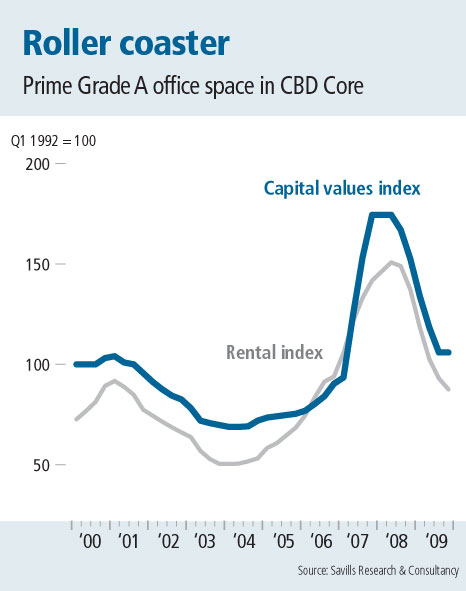
Consequently, Grade A office rents, which had been rising at a double-digit rate since 2007, tumbled from a peak of $15.10 per sq ft per month in Q2 2008 to $8.80 psf in Q4 2009. Taking into account the incentives provided by landlords, effective office rents now range from $6 to $8 psf per month.

Between 2010 and 2013, the rental correction may slow down as leasing demand rises to mop up the new supply entering the market. With the gradual return of business confidence, more companies are expected to revisit their office space planning with a view to expansion.

Recent trends seem to affirm this proposition as the market saw a slowdown in the surrender of unused space and a withdrawal of shadow space.

Nevertheless, the 10-year average demand of 670,000 sq ft per annum is well below the new supply entering the market at an average rate of 2 million sq ft per annum.

Grade A rent fell by 35 per cent last year and is predicted to continue falling albeit at a slower rate of 20-25 per cent this year before a plausible bottoming out in 2011/2012.

On a more positive note, the prospect of distress may bring the potential for opportunities.

First, the delayed rental recovery supported by sound market fundamentals might bode well for the Republic in the short term. Singapore and Hong Kong are often the preferred Asian cities for incorporation or expansion of businesses among foreign investors.

In a recent Savills survey that compared the top five buildings in each market, Hong Kong ranked first in terms of prime office costs, followed by Tokyo, then Singapore and Seoul in third place.
Due to limited supply, Grade A rents in Hong Kong are expected to rise between 5 and 10 per cent this year. The spike in rents could be further exacerbated as Hong Kong is likely to face a severe shortage of office space once current vacancies are filled.

Little is also expected in the way of new supply in Hong Kong with a mere one million sq ft per annum is likely to be added between 2010 and 2013.

A rising cost base in Hong Kong with the consolidation of regional office markets could result in many multinational corporations relocating their businesses to lower cost centres such as Singapore. Singapore’s advantage lies in its financial stability, cultural affinity and strategic location.

Hence, Singapore may outpace other Asian Tigers to be a premier gateway city for MNCs to expand their influence here in South-east Asia. In recent years, over 7,000 MNCs have set up their operational bases here, with more being expected to expand further as office rentals decline to more affordable levels.

Secondly, a more sanguine outlook for the office investment market has emerged with the turnaround of capital values in the latter half of 2009. Average Grade A capital values held steady at $1,700 per square foot (psf) in the fourth quarter of 2009, ending five quarters of decline.

In January 2010, a private fund of AEW Asia purchased Robinson Point for $203.25 million or $1,527 psf, a 20 per cent uplift from the $1,280 psf paid for Parakou Building, another office building located further down the street, in May 2009.

Outside the CBD, City Developments Ltd (CDL) sold the Office Chamber at Jalan Besar for $13.2 million or $940 psf in December 2009, and its majority stake in the 999-year leasehold North Bridge Commercial Complex near Bugis Junction for $46 million or $1,194 psf of strata floor area in November last year.

In the strata-office market, average capital values at Suntec City and The Central have increased by 5.7 per cent and 9.8 per cent quarter-on-quarter to $2,000 psf and $1,686 psf respectively in Q4 2009.

Due to more steady income derived from contractual rental streams, the office investment market could be an attractive alternative in the current market. As the office sector continues on its road to recovery, we could expect more investors to diversify into the office market.

Therefore, buying interest in the investment market is expected to gain momentum in 2010 and an increase of 5-10 per cent in Grade A capital values is likely for the full year. Buyers may also be looking to capitalise on possible long-term rental growth beyond 2010/2011.

Thirdly, the commercial landscape of Singapore is set to be rejuvenated with the emergence of a two-tier Grade A office market. New Grade A offices such as Marina Bay Financial Centre (3 million sq ft), Ocean Financial Centre (one million sq ft) and Asia Square (2.3 million sq ft) have begun to lace the city facade, raising Singapore’s office standards several notches higher with more efficient layouts, state-of-the-art facilities and larger floor plates.

Vacancies in the older Grade A and B buildings will continue to intensify. The situation could be exacerbated when tenants move out of existing buildings to new buildings like Marina Bay Financial Centre Towers 1 and 2 this year. This would continue to weigh down rents and may prompt landlords of older office buildings to upgrade or redevelop their investment properties to remain viable.

June Chua is director, commercial leasing, and Christine Sun is senior manager, research & consultancy, Savills (Singapore) Pte Ltd

Source : Business Times – 25 Mar 2010
More auctions expected in high-end residential sector

The market is likely to chalk up more than $200 million worth of transactions this year, says GRACE NG

IT was a stellar year for auctions last year despite the unfavourable market conditions. About $168.4 million worth of properties were sold at auctions in 2009, doubling the $83.67 million done in 2008.

The residential sector was the star performer, chalking up $88.4 million worth of transactions, or slightly over half the total sales value. The retail sector was the next best performer, with $43.4 million worth of sales.

Strong interest was seen for shops and shophouses, as investors chose to park their money in higher yielding investments rather than keep it in the bank for paltry interest rates. The sector that saw the highest growth rate was industrial property. Sales value jumped 223 per cent, from $6.2 million in 2008 to $20 million last year.

Buoyant market pushes up sales

Mirroring the buoyant sales in the primary residential market, residential properties at auctions saw a 250 per cent jump in sales value in 2009. The figure soared from $25.2 million in 2008 to $88.4 million last year.

More residential buyers are turning their attention to auction sales because the properties available at auctions are deemed to be better value for money as most of the older properties tend to have much larger land or built-up areas.

In addition, buyers who are owner-occupiers can move into the property when the sale is completed, which is typically three months after the payment of deposit. In comparison, purchasing from a developer could mean a wait of about two years before the property is ready for occupation.

Popular picks in 2009

# Landed properties: Terrace and semi-detached. In our land-scarce country, owning a landed property remains the aspiration of many Singaporeans. It is also a status symbol, as these properties are only available to Singaporeans and permanent residents with approval from the Land Dealings (Approval) Unit.

Even though landed properties do not come with facilities like those found in cluster housing or condominiums, they remain popular, as such properties usually have a private garden and car porch and do not have maintenance charges. Thus, it is not surprising that landed houses have become popular at auctions.

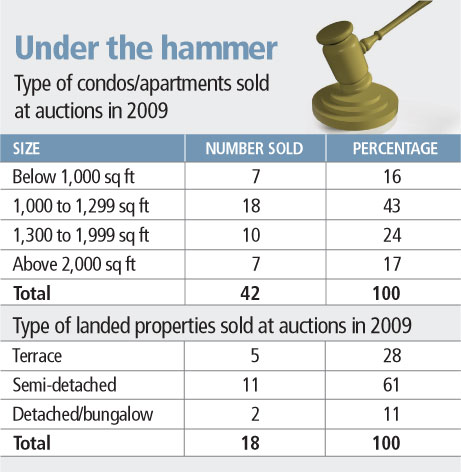
In 2009, terrace houses costing around $1 million and below were in demand because of their affordability. Five terraces were sold at prices ranging from $820,000 to $1.25 million.

Corner terraces and semi-detached houses, especially those that sit on large land areas, were the favourites, as these properties are rarely available. A total of 11 semi-detached houses were sold during the year at prices ranging from $1.05 million to $3.7 million. The majority of the transactions were below $2 million and the properties had land areas ranging from 2,400 sq ft to 4,414 sq ft.

Buyers also favoured semi-detached houses with large land areas. Nine of the 11 semi-detached houses sold at last year’s auctions had land areas in excess of 3,500 sq ft.

The popularity of this type of property can be attributed to the fact that newer semi-detached houses have smaller land areas of about 2,150 sq ft, which could translate to a higher price per sq ft.

# Apartments with large floor areas: With developers building smaller apartments – some of them dubbed Mickey Mouse flats – in their new developments, the older and larger apartments have become a popular alternative at auctions with owner-occupiers as well as upgraders.

Apartments in the secondary market are generally larger with a 2-bedroom unit averaging 800 sq ft, a 3-bedroom 1,250 sq ft and a 4-bedroom unit 1,800 sq ft. In comparison, new apartments today are much smaller starting from 300 sq ft for a studio, 527 sq ft for a 2-bedder and 861 sq ft for a 3-bedder.

Given the limited number of large apartments in the primary market, many throng the auction halls in search of their ideal apartments. Apartments ranging from 1,000 sq ft to 1,299 sq ft were popular at auctions. Eighteen out of the 42 units sold last year fell within this category.

The apartments bought were at various locations. At International Plaza at Tanjong Pagar, a 1,033 sq ft 2-bedroom apartment was sold at auction for $800,000. At Shanghai One in River Valley, an 883 sq ft 2-bedroom unit went for $1.08 million and in Oxford Road, a 1,097 sq ft 2-bedroom apartment in Kentish Green was sold for $620,000.

# Properties below $1million: Apartments and condominiums below $1 million were popular too, as evidenced by the 27 successful transactions seen in this category out of the 42 made available at auctions.

# Apartments in prime districts: The other property type that was sought after at auctions in 2009 was high-end apartments. Apartments located in the prime inner city and District 10 under mortgagee sales were in demand. Two apartments at The Clift were sold for $605,000 and $1.047 million. Another two apartments at Four Seasons Park were sold for about $4.8 million each.

What will be popular in 2010?

In line with the recovery in the high-end sector, homes in districts 9, 10, 11, as well as prime inner city and Sentosa, will continue to be popular at auctions. We can expect to see an increase in sales of homes in these areas this year. The proportion of apartment sales is likely to rise to 35 per cent compared with 29 per cent achieved last year.

The opening of the two integrated resorts (IRs) will enhance Singapore’s reputation as a world-class city. Residential properties located near the two IRs were given a boost in value as a result, and were in demand as buyers aimed to cash in on the market.

Apartments such as The Sail and Marina Bay Suites, as well as properties in Sentosa Cove, will be sought after by investors and owner-occupiers alike.

Prices of high-end homes in the Core Central Region are still about 11 per cent below their Q1 2008 peak. Improving market sentiment in line with the recovery in the economy, ample liquidity and a low interest rate environment, as well as a hunger for alternative investment opportunities, are factors pointing to a recovery.

As such, we are likely to continue to see owners taking the auction route this year to sell their high-end properties in hopes of achieving the best price through competitive bidding.

We could also see some developers exploring auctions as a mode of sale for their properties if the high-end market picks up steam.

Some developers had success when they used an auction to sell their high-end properties. For instance, 12 parcels of bungalow land in Sentosa Cove were successfully auctioned off in 2006 for a total value of $86.34 million.

And in 2007, another developer successfully auctioned 12 luxury apartments at The Botanika for $52.92 million, which set new benchmark prices for the area.

The competitive bidding helped these developers achieve record prices for their developments, and they also gained international exposure as the auctions were beamed live via satellite to cities such as Hong Kong, Jakarta, London and Sydney to tap foreign buyers.

With an improved economy, the number of properties sold at auctions this year should rise to more than 140, from the 118 seen in 2009.

More activity is expected in the high-end residential sector and this is likely to boost the sales value at auctions. As such, the market is likely to chalk up more than $200 million worth of transactions this year.

Grace Ng is deputy managing director (agency & business services) and auctioneer, Colliers International

Source : Business Times – 25 Mar 2010